An unexpected announcement by the OPEC+ group of oil producing countries of a plan to slash their combined (daily) output by another 2.4% following a meeting of the world's largest oil producing nations. Reacting to the move prices of crude oil rose by as much as 6% in early Monday trading.
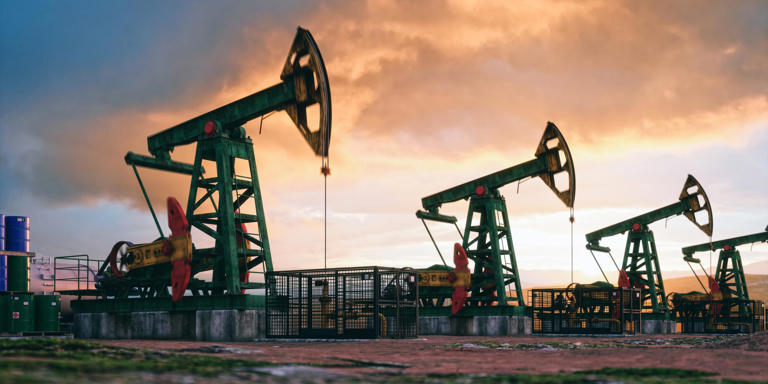
The oil producers, who control 50% of global oil supplies, reached a decision to reduce their output starting from May until the end of 2023, in a move designed to stabilise the markets, according to a series of announcements on Sunday night.
Riyadh said it would cut its output by 500,000 barrels per day, while Baghdad announced a cut of 211,000 bpd. The UAE will reduce production by 144,000 bpd, Kuwait will cut 128,000 bpd, Kazakhstan 78,000 bpd, Algeria 48,000 bpd, and Oman 40,000 bpd.
Crude prices jumped on the news, with international benchmark Brent rising more than 5.5% to $84.30 a barrel, while US West Texas Intermediate crude futures soared 5.6% to $79.90 a barrel as of 9:00am GMT on Monday.
Russia already voluntarily cut oil output by 500,000 bpd back in March, in retaliation for an oil price cap introduced by the West, which it said would eventually result in scarce supply and trigger uncertainty in the global market. On Sunday, however, Moscow announced it will synchronize with OPEC in extending its cut until the end of the year.
Moscow believes the move will contribute to the stabilization of crude oil prices, which fell sharply on concerns that the Western banking crisis could lead to weaken global energy demand if the world falls into recession.
The Saudi Ministry of Energy called the move a “precautionary measure aimed at supporting the stability of the oil market.” Last month, Saudi Energy Minister Prince Abdulaziz bin Salman warned Western states against capping the price of crude oil supplied by the kingdom, adding that any attempts to impose a ceiling would be met with a halt of sales and production cuts.
The move left Washington disappointed, as it comes in defiance of US pressure on oil producers to increase their production and lower the prices. President Joe Biden even travelled to Riyadh last July to petition Crown Prince Mohammed bin Salman directly, to no avail. The USA is the world's second largest importer of crude oil, behind China, importing more than 10.8 billion barrels per year. This is likely to further stall the world's second largest economy which is struggling to achieve pre-covid growth rates as it grapels with low economic growth, higher prices and spiralling debt. The governments of India, South Korea and Japan, as the world's third, fourth and fifth largest importers of the oil are also likely to be concerned about the effect of higher oil prices as each struggles to contain inflation.
“We don't think cuts are advisable at this moment given market uncertainty – and we've made that clear,” a spokesperson for the National Security Council told Reuters on Sunday.
Table 1: Largest producers of oil (selected nations 2023)
Nation
Crude oil production (barrels m)
Oil exports as a % of exports
Oil exports as a % of government revenue
Saudi Arabia
10,644,394
90
85
Russia
10,278,370
45
36
Iraq
4,470,506
95
90
United Arab Emirates
3,467,870
13
50
Iran
3,293,401
90
60
Nigeria
1,316,415
98
83
Angola
1,165,993
90
70
Questions
a. Define the following terms from the passage:
i. Demand (line 21) [2]
The quantity of goods and services that consumers are willing and able to pay for a good or service (oil) at a given price, in a given time period.
ii. Recession (line 21) [2]
When the economy contracts (measured by GDP) for two consecutive periods.
b. Using the information contained in lines 2-4, calculate the price elasticity of supply for crude oil. [3]
1.2 / 6 = 0.2 (note that the figure of 1.2 is derived from a 2.4% cut in OPEC nations which control half of world global supply.
c. Explain why the PED of oil might be inelastic. [2]
As a primary good oil is relatively difficult or at least time consuming to get out of the ground and so sudden changes in supply are difficult - even when the price changes significantly. This is because there is little spare capacity to suddently bring online (when prices rise) and it is also difficult (or time consuming) to close oil fields or restrict the flow of oil being extracted.
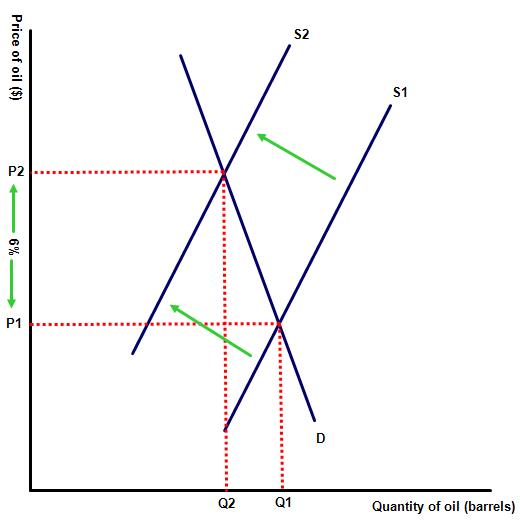
d. Illustrate using a suitable diagram why the largest suppliers of oil are likely to see a rise in overall revenues following the 6% rise in world oil prices. [4]
As the diagram illustrates following a rise in the price of oil from P1 to P2, quantity demanded for the commodity falls lower than proportionately, shown by Q1 to Q2.
e. Suggest two reasons why consumers of oil may not be able to reduce their purchases of oil in response to the rise in price of the commodity? [4]
As a basic necessity consumers are relatively unresponsive to changes in price because of a lack of substitutes for the product. For example, if you drive a petrol car you cannot suddenly change this to use an alternative energy source. Oil is also considered a basic necessity, as consumers cannot for example, refrain from heating their homes or driving their cars - activities which all require oil.
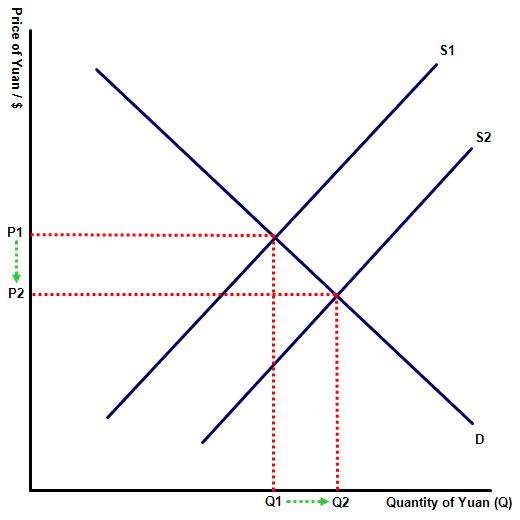
f. Illustrate using a suitable diagram the impact of the price rise on the exchange rate of the Chinese Yuan. [4]
As a significant importer of oil China will now have to spend more Yuan on importing the commodity, shown by a right shift in supply from S1 to S2, resulting in a new equilibrium price level of P2.
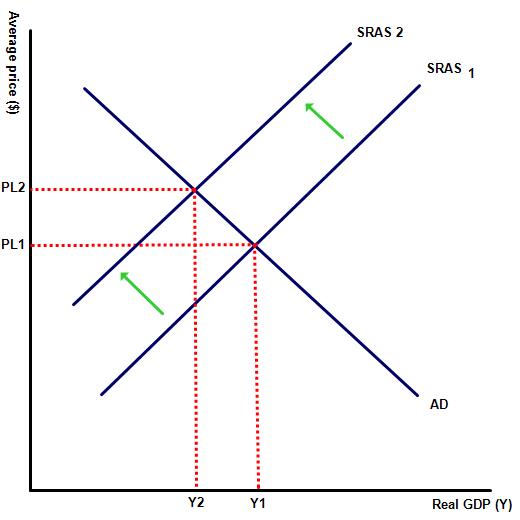
g. Explain using a suitable diagram the effect of the effect of higher oil prices on the inflation rates within the largest oil importing nations? [4]
The largest importers of oil will see a rise in production costs, resulting in cost-push inflation - shown on the diagram by the increase from PL1 to PL2 as the higher import costs feed through into the economy in the form of higher final prices in the shops.
h. Using the information contained in table one and your knowledge of economics discuss the role of oil in promoting sustainable economics growth with LEDC nations. [15]
Sustainable development can be described as development that meets the needs of the present without compromising the ability of future generations to meet their own needs. [Key term defined]
On one hand there is little doubt that the oil industry is capable of generating significant revenues for a nation and this is particularly the case when the industry operates within a LEDC. In turn the revenue generated from oil can then be used to finance improvement in education and health services, leading to rises in human development and more sustainable long-term economic growth within the country. [Opening argument identified].
As table one highlights, nations with vast oil reserves can enjoy significant revenues, through exporting the commodity, while the industry also generates large numbers of well-paid jobs and tax revenue for the government. For each of the nations identified in table 1, for example, oil generates almost almost all of the nation's oil revenues as well as the lions share of government revenues. [Application].
Another advantage for a nation with substantial oil reserves is the relative low price elasticity of the commodity. This allows the oil producing nations to raise the price of each barrel, as illustrated in the article and export revenues will rise.This is shown by the diagram to the right, where following a rise in the price of each barrel of oil sold, from P1 to P2, quantity demand falls lower than proportionately resulting in higher revenues for the oil producing nations. [Analysis].
While many other commodities produced by developing nations share the PED inelasticity of oil food stuffs, metals e.t.c. oil has the additional advantage of being income elastic (YED). This has meant that while a number of developing nations have seen their terms of trade diminish over time, as higher world incomes have led to a smaller than proportional rise in demand for their commodities, oil producing nations have enjoyed steadily rising terms of trade (through higher demand for oil). [Analysis].
A further advantage enjoyed by oil producing nations is the impact on their own domestic production, with oil playing a significant role in the produciton process of many industries. [Application]. As USA recently discovered, when it found vast deposits of shale oil and shale gas, America suddenly experienced a sharp fall in production costs and was able to 'reshore' manufacturing industries that appeared lost to low wage labour nations just ten years previously. [Analysis]. As a result of lower energy costs USA experienced cost-push disinflation, shown on diagram two by the fall in average price level from PL1 to PL2 and a rise in real GDP shown by Y1 to Y2. [Analysis].
On the other hand, nations with significant oil reserves have not always been successful in converting this resource wealth into improvements in the nation's standard of living. [First counter argument identified]. This has sometimes been referred to as the resource curse and describes countries with an abundance of natural resources (such as oil) having less economic growth, less democracy, or worse development than countries with fewer natural resources. [Application].
As table one identifies many oil endowed nations become more autocratic as the ruler's optimal strategy for political survival is to use that revenue to buy the loyalty of critical support groups, rather than investing in developing the nation's physical and human infrastructure. education and infrastructure. By contrast, in a dictatorship with few natural resources, there may be a necessity for the ruler to liberalize his society somewhat so that the economy can be organized more efficiently, and to invest in education and healthcare to create a skilled and healthy workforce. [Evaluation].
A second reason why some economists argue that an abundance of oil (or other minerals) may not promote sustainable economics growth with LEDC nations is sometimes referred to as the Dutch disease. [Second counterargument identified]. This describes the process whereby as a nation exports more and more oil its currency appreciates, making it more difficult to export other products. [Application]. In a number of the nations included in table one oil makes up 90% of export revenues and with the currency value linked to the price of oil, other tradable goods beome less competitive in world markets. [Analysis].
A third disadvantage for developing nations can also be that while oil (and other minerals) produce very large export revenues for the government, which can then be used to finance development in the economy the revenues received are nether-the-less extremely volatile with the price of oil fluctuating significantly. [Application]. Where this revenue source makes up a significant proportion of a nation's government and export revenues, a sudden plunge in oil prices can leave a nation with a sudden and dramatic budget/current account deficit. [Analysis]. While the article, of course, highlights that oil producing nations can control the price of oil (through small changes to supply) this can only be achieved when working collaboratively and an individual nation cannot automatically agree that other OPEC nations will necessarily agree to cut production levels whenever it suits a particular nation for them to do so - leaving the nation's finances highly volatile and subject to external economic conditions over which they have no control. [Evaluation].
In conclusion, therefore, it can be established that while significant oil reserves can provide enormous economic benefits to a nation it cannot automatically presumed that a developing nation will necessarily be able to take advantage of this geographical luck to improve the living standards of its citizens. [Conclusion].
Feedback
Which of the following best describes your feedback?


 The oil producers, who control 50% of global oil supplies, reached a decision to reduce their output starting from May until the end of 2023, in a move designed to stabilise the markets, according to a series of announcements on Sunday night.
 The Saudi Ministry of Energy called the move a “precautionary measure aimed at supporting the stability of the oil market.” Last month, Saudi Energy Minister Prince Abdulaziz bin Salman warned Western states against capping the price of crude oil supplied by the kingdom, adding that any attempts to impose a ceiling would be met with a halt of sales and production cuts.
 As the diagram illustrates following a rise in the price of oil from P1 to P2, quantity demanded for the commodity falls lower than proportionately, shown by Q1 to Q2.
 As a significant importer of oil China will now have to spend more Yuan on importing the commodity, shown by a right shift in supply from S1 to S2, resulting in a new equilibrium price level of P2.
 The largest importers of oil will see a rise in production costs, resulting in cost-push inflation - shown on the diagram by the increase from PL1 to PL2 as the higher import costs feed through into the economy in the form of higher final prices in the shops.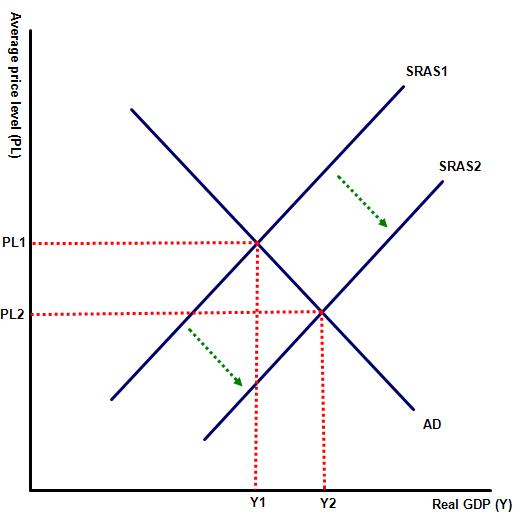
 Twitter
  Facebook
  LinkedIn