

How to write a successful internal assessment portfolio
The IA portfolio consists of three internal assessments, each 800 words and in most cases one will be on microeconomics, the second macroeconomics and then (in year 2 of your course) one IA on global economics. The  steps in the process include:
- Finding a suitable commentary
- Choosing an appropriate key concept (you may only use each concept just once)
- Write your first draft, submitting it to your teacher for feedback
- Write the final draft
- Once all three IAs are complete prepare a summary cover sheet and include each article in your portfolio.
Choosing an article
The easiest way is to search for an article, via the Internet and you will be able access articles by putting suitable command terms into a search engine. Articles can be in any language but will need to be translated into the working language of the school. All articles must be from three different sources and published no longer than 12 months before the commentary is written. As a general rule shorter articles can be easier to use than longer ones, given the strictly enforced word limit of 800 words. If you find an article that you particularly want to use, which is very long or contains multiple points then simply highlight the sections of the article that you wish to base your IA on.
What is appropriate source for an article?
Most sources are suitable for you to use but not personal blogs, Facebook pages, advertisements, statistical tables or government reports. While many examiners do not like the use of the “Economist” you will not be penalised for using this source.
Structuring an internal assessment

 When writing the IA a common misconception by many IB students is that the task involves simply summarising or paraphrasing the article. Instead examiners are looking for evidence that the candidate has related the article to the economic theory that they have learnt during their course. Try to remember that the aim of each commentary is to demonstrate your ability in the subject. Commentaries that are little more than a summary of the article will score poorly.
Try to think very carefully about what you intend to include in your commentary and not write anything which will not directly lead to marks from the criteria. Quotes from the article are good and should be included but must be short in length – no more than 2 sentences in length. One short sentence in length is better still.
Your commentary is about a deep understanding of one part of the course so when you start writing your commentary think first about what is the appropriate economic concept or theory and stick to this – do not jump around between topics. For instance do not start writing a commentary about international trade and then dedicate paragraphs to the impact on national income. This is because they are separate sections of the course and each commentary needs to be based on a separate section of the course – microeconomics, macroeconomics and International / development economics.
The structure of the commentary
When submitting your commentary you will include, for each commentary, the article itself plus the following information:
- the title of the article
- the source of the article
- the date the article was written - this must have been written after you started your II course
- the word count of the commentary
- the date the commentary was written - must be within 12 months of when the article was written
- the relevant section of the syllabus
- the relevant concept.
Structuring your work
Try to stick to the following structure as closely as possible. Start with your introduction, stating briefly what the central theme of the article is and this is also where you include your definitions and command words. Unlike the exam, however, you are not required to  write down a list of definitions. Instead candidates are expected to use terms ‘appropriately’. Only two marks are available for this section. Use only economic terminology so rather than saying buyer or customer use the word consumer, expenditure rather than spending, utility rather than pleasure e.t.c.
The main skill of writing the commentary is to focus on one really important economic concept and develop it. If there is more than one economic theory in the article, stay focused on this rather than getting distracted by other areas of the syllabus. The IB allows you to highlight which of the features you are choosing to focus on when completing your work. This should be around 150 words in length.
Draw the diagram
After your introduction you should draw your main diagram. This should be given a title and be fully labelled. None of this is included in your word count. The diagram that you choose should be the problem explained in the article. The diagram  should also include your solution to the problem.
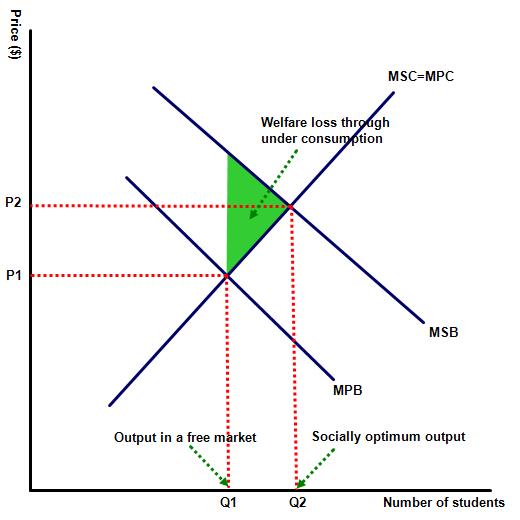 The diagram to the right, for example, relates to an article focusing on schemes to encourage more people to cycle in a city. The diagram includes the social costs of the externality and the size of the welfare loss, from the current situation where the number of bicycles purchased is perceived to be below the socially optimum level. The equilibrium level of output (Q1) and the socially efficient level (Q2) are labelled.
Include in your diagram the following:
- a full title such as, 'The bicycle market in a city'
- label each axis and each line or curve. Do not simply write price and quantity, write specific prices and quantities included in the article and label each axis e.g. price of bicycles (ϵ), bicycles purchased (millions).
- In complex diagrams you might also find it useful to allocate a letter to key intersection points. This will make it easier to refer back to them later in your explanation.
- lastly, shade in areas or shapes in your diagram, for instance the welfare loss as a result of the under consumption of bicycles.
Explain your diagram (200 words)
This should be a full explanation including how the key concepts work. Start from the basis that you are trying to explain your diagram to somebody who is not an expert in the subject. Describe the diagram step by step. For example in the diagram to the left we have illustrated how more journeys made by bicycles could provide a solution to a city’s congestion problems, e.g.
The market for bicycles is shown in the diagram with the market in equilibrium at Qe and Pe, below the socially optimum level of Qso. At the equilibrium level of output, Qe the MSB of consumption are above the MSC, indicating that the good is under demanded, resulting in the loss of potential gain (welfare loss).
Sometimes both the problem and the solution can be illustrated on one diagram and on other occasions it cannot.
Develop Your argument (100 words)
Having explained your diagram you should now focus on developing your solution and this is where you link the article to  the economic theory that you have learnt in your course. So in the example above the article may be about bicycle use in a city. However, your commentary should focus on the concepts of externalities and how governments may internalise the externalities, by encouraging greater bicycle use e.g. more cycle paths, paid out of a pigovian tax on cars, rather than the traffic congestion itself.
Continuing from the example above we could say:
The size of the financial support allocated to bicycle lanes should be equal or greater to the size of the negative externality. For instance if the government calculates that the under consumption of bicycles creates 100 million $ per day in external costs and there are currently 10 million cars entering the city, each day, then the size of the tax should be $ 10 per day.
Evaluation (250 words)
Evaluation means that you should evaluate your solution to the problem, including looking at the strengths and weaknesses of the solution you have identified. As part of this section alternative solutions e.g. a bicycle rental scheme such as the ones already operating in many European cities, should be considered and again illustrated on your diagram, by a rise in demand for bicycle journeys in the city.
Key concept (new syllabus 50 words)
Include references to the key concept throughout the commentary, highlighting the concept whenever it is used. You should also add in a separate (stand alone) paragraph explaining how the key concept is relevant to the chosen article.
Conclusion
50 words on a concluding sentence or two.
Bibliography
The last part of your commentary and the words included here, like the title page, diagrams e.t.c. are not included in the word count.

Global economics model answer
This section includes model answers for the internal assessment. Start by reading the article included and then make notes on how you would structure your IA. Finally, click on the little eye to view my model response.

Macroeconomics model answer
This section includes model answers for the internal assessment. Start by reading the article included and then make notes on how you would structure your IA. Finally, click on the little eye to view my model response.

Microeconomics model answer
This section includes model answers for the internal assessment. Start by reading the article included and then make notes on how you would structure your IA. Finally, click on the little eye to view my model response. Title of the article: Scotland...
 Twitter
  Facebook
  LinkedIn