Lebanon’s currency value plunges to 100,000 against US dollar
The Lebanese pound, after many decades pegged at 1,507-1,512 to the US$, has sunk to a historic low against the US dollar on the country’s parallel market, the latest sombre milestone in an economic meltdown that has plunged much of the population into poverty.
The Lebanese pound, officially pegged at 15,000 to the dollar, was trading at 100,000 against the greenback, dealers said on Tuesday – a dizzying plunge from 1,507 before the economic crisis hit in 2019.
Table 1: Lebanese economy May 2022 to May 2023
May 2022
May 2023
Value of US$ to Lebanon £
1,507
15,307
Lebanese economic growth
-6.5%
-5.75
Inflation %
121.59
123.89
Current account balance $ million
-673.6
-854.5
Questions
a. i. Explain the difference between the official rate of 15,000 to 1$ and the parallel market rate of 100,000. [2]
Citizens exchanging Lebanese £s for US$s via official (government approved) agencies will only receive £15,000 for each $ exchanged. It is unlikely that the same exchange offices will give citizens $1 for £15,000 exchanged. However, unlicensed exchanges will exchange £s for $s at the unofficial rate of 100,000 to 1$.
ii. Calculate the cumulative change in economic growth and inflation between May 2022 and 2023. [4]
Economic growth - 12.62%
Inflation - 249.04%
iii. Explain with a diagram the pegging of the Lebanese £ at 1,507-1,512 to the US$ [4]
Under a fixed rate or 'peg' the Lebanese central bank must hold large quantities of foreign currency, in this case US$ to stabilise the currency at the official price. This is done by ensuring that supply and demand are in permanent equilibrium. If, for example, the nation increases its imports, increasing the supply of Lebanon £ in international markets then the central bank must increase its own purchases of the currency to maintain the equilibrium.
iv. Explain why the Lebanese £ may have depreciated since May 2022 [2]
The £ will have depreciated as a result of either a rise in supply, as Lebanese citizens increasingly want to exchange their £s for more secure currencies and/or overseas citizens are reducing their demand for the £ (fewer overseas residents are purchasing Lebanese exports)
v. Illustrate the effect of the fall in the value of the Lebanese £ on the rate of inflation (table 1) [4]
The sharp depreciation of the currency will have led to inflationary pressures throughout the economy, shown by a fall in aggregate supply as production costs have risen, forcing up average prices from PL1 to PL2. Production costs will rise because firms will use a proportion of imported components / supplies in their own products.
vi. Suggest why the falling currency value and inflation may have 'plunged much of the population into poverty' [4]
The falling currency value and inflation may have 'plunged much of the population into poverty' for two reasons. Firstly, when hyper inflation (over 100%) affects an economy wages almost never rise at the same rate, meaning a fall in real income levels. This is particularly true for citizens on fixed incomes such as pensioners. Secondly, the spending power of Lebanese citizens, in terms of the value of savings and / or income will be almost worthless in terms of other currencies, making purchases of imported products near impossible - except for a small elite of families fortunate enough to secure access to $s or another hard currency themselves.
b. Using the passage and your knowledge of economics recommend a policy that the Egyptian central bank may employ to support the £ in currency markets. [10]
Exchange rate can be defined as the price of one currency (Lebanese £) relative to another ($). The central bank is the authority in charge of monetary policy, including exchange rate policy. [Key terms defined]. The policy that I am recommending the central bank to undertake is to increase interest rates in the country in order to strengthen the value of the Lebanon £. [Policy identified].
While there are a number of factors that determine the value of an exchange rate e.g. the rate of inflation, a nation's current account balance, public debt and the overall strength of the economy, interest rates are a key determinate and one that the central bank has a large degree of control over. [Application].
If it were possible to remove all of the other elements that contribute to the value of a currency, an increase in the interest rate would cause the value of a currency to rise. Essentially, this is because higher interest rates in a particular currency offer investors (those who buy a currency) a higher return relative to other currencies. This is sometimes referred to as 'hot money flows'. [Analysis]. As more investors are attracted, demand for the currency increases, and its value goes up, as illustrated in the diagram. [Evaluation].
Furthermore, higher interest rates will not only attract overseas investors to a currency but will also act as an incentive for Lebanese citizens to keep hold of their currency, rather than automatically converting their salaries/savings directly into US$. [Evaluation].
Increases in interest rates are also associated with lower levels of inflation which can cause the value of a currency to rise. This is because when a central bank raises interest rates private consumption is discouraged (as individuals increase their level of savings instead). [Analysis]. This in turn lowers demand for overseas goods and services (imports), reducing the supply of the currency. This is because households purchasing imported goods and services effectively supply their own currency in order to purchase the foreign currency in order to buy the product. [Evaluation].
Of course, a policy of higher interest rates is not without its weaknesses. The policy can be effective in strengthening the value of the currency but the policy comes at a cost - namely higher interest rates reduces spending power in the economy, as it becomes more expensive to take out loans for large ticket items. [Analysis]. Therefore, any central bank considering this policy must strike a balance between supporting the currency and supporting consumption in the domestic economy. [Summary conclusion].
Feedback
Which of the following best describes your feedback?


 Lebanon’s currency value plunges to 100,000 against US dollar
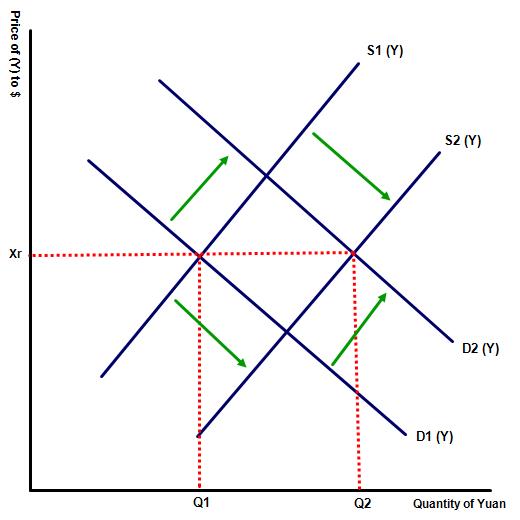 Under a fixed rate or 'peg' the Lebanese central bank must hold large quantities of foreign currency, in this case US$ to stabilise the currency at the official price. This is done by ensuring that supply and demand are in permanent equilibrium. If, for example, the nation increases its imports, increasing the supply of Lebanon £ in international markets then the central bank must increase its own purchases of the currency to maintain the equilibrium.
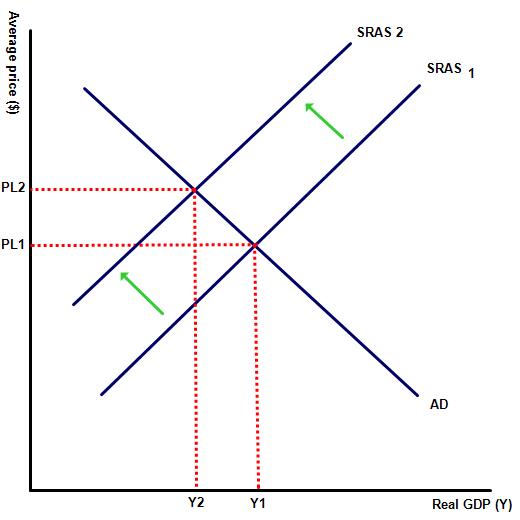 The sharp depreciation of the currency will have led to inflationary pressures throughout the economy, shown by a fall in aggregate supply as production costs have risen, forcing up average prices from PL1 to PL2. Production costs will rise because firms will use a proportion of imported components / supplies in their own products.
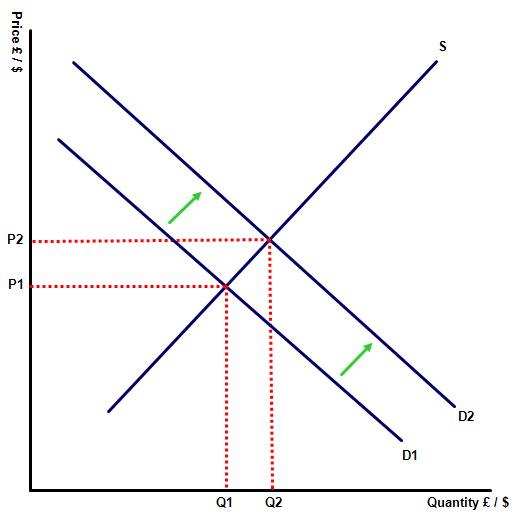 interest rate would cause the value of a currency to rise. Essentially, this is because higher interest rates in a particular currency offer investors (those who buy a currency) a higher return relative to other currencies. This is sometimes referred to as 'hot money flows'.
  Twitter
  Facebook
  LinkedIn