

Global growth to slow through 2023, adding to risk of ‘hard landing’ in developing economies.
Following a strong rebound in 2021, the global economy is entering a pronounced slowdown amid fresh threats from COVID-19 variants and a rise in inflation, debt, and income inequality that could endanger the recovery in emerging and developing economies, according to the World Bank’s latest Global Economic Prospects report. Global growth is  expected to decelerate markedly from 5.5 percent in 2021 to 4.1 percent in 2022 and 3.2 percent in 2023 as pent-up demand dissipates and as fiscal and monetary support is unwound across the world.
The rapid spread of the Omicron variant indicates that the pandemic will likely continue to disrupt economic activity in the near term. In addition, a notable deceleration in major economies—including the United States and China—will weigh on external demand in emerging and developing economies. At a time when governments in many developing economies lack the policy space to support activity if needed, new COVID-19 outbreaks, persistent supply-chain bottlenecks and inflationary pressures, and elevated financial vulnerabilities in large swaths of the world could increase the risk of a hard landing.
“The world economy is simultaneously facing COVID-19, inflation, and policy uncertainty, with government spending and monetary policies in uncharted territory. Rising inequality and security challenges are particularly harmful for developing countries,” said World Bank president David Malpass. “Putting more countries on a favourable growth path requires concerted international action and a comprehensive set of national policy responses.”
The slowdown will coincide with a widening divergence in growth rates between advanced economies and emerging and developing economies. Growth in advanced economies is expected to decline from 5 percent in 2021 to 3.8 percent in 2022 and 2.3 percent in 2023—a pace that, while moderating, will be sufficient to restore output and investment to their pre-pandemic trend in these economies. In emerging and developing economies, however, growth is expected to drop from 6.3 percent in 2021 to 4.6 percent in 2022 and 4.4 percent in 2023. By 2023, all advanced economies will have achieved a full output recovery; yet output in emerging and developing economies will remain 4 percent below its pre-pandemic trend. For many vulnerable economies, the setback is even larger: output of fragile and conflict-affected economies will be 7.5 percent below its pre-pandemic trend and output of small island states will be 8.5 percent below.
Meanwhile, rising inflation—which hits low-income workers particularly hard—is constraining monetary policy. Globally and in advanced economies, inflation is running at the highest rates since 2008. In emerging market and developing economies, it has reached its highest rate since 2011. Many emerging and developing economies are withdrawing policy support to contain inflationary pressures—well before the recovery is complete.
The latest Global Economic Prospects report features analytical sections that provide fresh insights into three emerging obstacles to a durable recovery in developing economies. The first, on debt, compares the latest international initiative to tackle unsustainable debt in developing economies—the G20 Common Framework—with previous coordinated initiatives to facilitate debt relief. Noting that COVID-19 pushed total global debt to the highest level in half a century even as the creditors’ landscape became increasingly complex, it finds that future coordinated debt relief initiatives will face higher hurdles to success. Applying lessons from the past restructuring to the G20 Common Framework can increase its effectiveness and avoid the shortcomings faced by earlier initiatives.
“The choices policymakers make in the next few years will decide the course of the next decade,” said Mari Pangestu, the World Bank’s Development Policy and Partnerships, MD “The immediate priority should be to ensure that vaccines are deployed more widely and equitably so the pandemic can be brought under control. But tackling reversals in development progress such as rising inequality will require sustained support. In a time of high debt, global cooperation will be essential to help expand the financial resources of developing economies so they can achieve green, resilient, and inclusive development.”
The second analytical section examines the implications of boom-and-bust cycles of commodity prices for emerging market and developing economies, most of which are heavily dependent on commodity exports. It finds that these cycles were particularly intense in the past two years, when commodity prices collapsed with the arrival of COVID-19 and then surged, in some cases to all time-highs last year. Global macroeconomic developments and commodity supply factors will likely cause boom-bust cycles to continue in commodity markets. For many commodities, these cycles may be amplified by the forces of climate change and the energy transition away from fossil fuels. The analysis also shows that commodity-price booms since the 1970s have tended to be larger than busts, creating significant opportunities for stronger and more sustainable growth in commodity-exporting countries—if they employ disciplined policies during booms to take advantage of windfalls.
The third analytical section explores COVID-19’s impact on global inequality. It finds that the pandemic has raised global income inequality, partly reversing the decline that was achieved over the previous two decades. It has also increased inequality in many other spheres of human activity—in the availability of vaccines; in economic growth; in access to education and health care; and in the scale of job and income losses, which have been higher for women and low-skilled and informal workers. This trend has the potential to leave lasting scars: for example, losses to human capital caused by disruptions in education can spill over across generations.
Ayhan Kose, Director of the World Bank’s Prospects Group, said: “In light of the projected slowdown in output and investment growth, limited policy space, and substantial risks clouding the outlook, emerging and developing economies will need to carefully calibrate fiscal and monetary policies. They also need to undertake reforms to erase the scars of the pandemic and grow their economies.”
Regional Outlooks:
| Region | Expected growth (2022) | Expected growth (2023) |
| East Asia and Pacific | 5.1 | 5.2 |
| Europe and Central Asia | 3.0 | 2.9 |
| Latin America and the Caribbean | 2.6 | 2.7 |
| Middle East and North Africa | 4.4 | 3.4 |
| South Asia | 7.6 | 6.0 |
| Subsahran Africa | 3.6 | 3.8 |
Source: Worldbank.org
Questions
a. Define the following terms identified in the passage:
i. Inflation (line 2) [2]
ii. Income inequality (line 2) [2]
b. Calculate the average rate of economic growth between 2021 and 2023 for the following:
i. World (lines 4-5)
ii. Emerging and developing economies (lines 21-22) [3]
iii. Explain the difference between 'emerging' and 'developing economies' (line 12) [2]
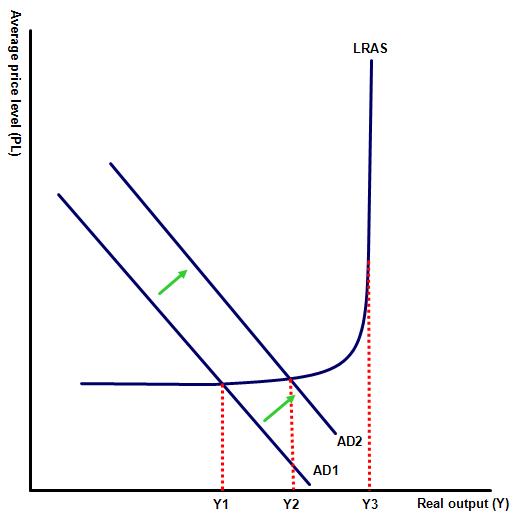
c. Illustrate on a suitable diagram the impact on the global economy of the expected slowdown in 2022-2023 resulting from the 'fresh threats from COVID-19 variants, inflation and debt'. (lines 1-2) [4]
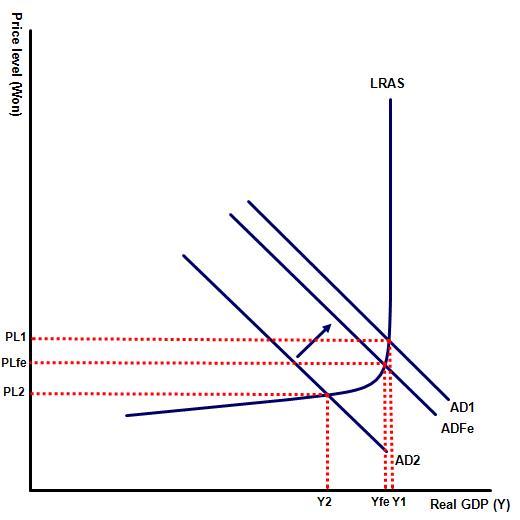 As the diagram illustrates national income (world) in 2021 is represented by Y2, where AD (2021) intercepts with the LRAS curve. Without the unexpected slowdown in the global economy then real GDP would have likely been at Y1 but settled at the lower growth level of Yfe.
d. Illustrate on a suitable diagram the impact on emerging and developing economies of 'persistent supply-chain bottlenecks' on inflation. (line 14) [4]
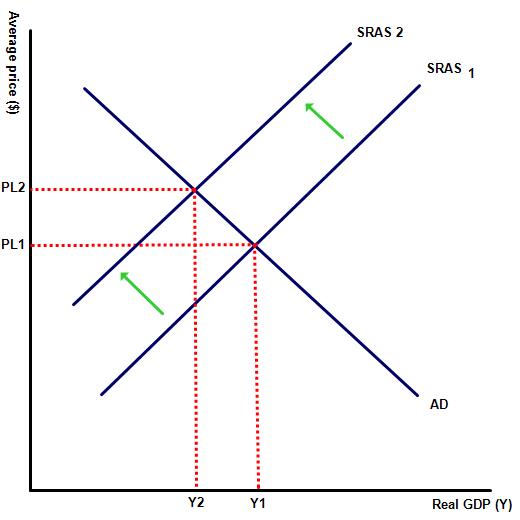 The impact on emerging and developing economies of 'persistent supply-chain bottlenecks' has created cost-push inflation as a result of rising production costs, shown on thw diagram by a rise in average prices from PL1 to Pl2 and a fall in national income from Y1 to Y2.
e. Explain using a suitable diagram the impact of constraining (contractionary) monetary policy on global economic growth (line 28) [4]
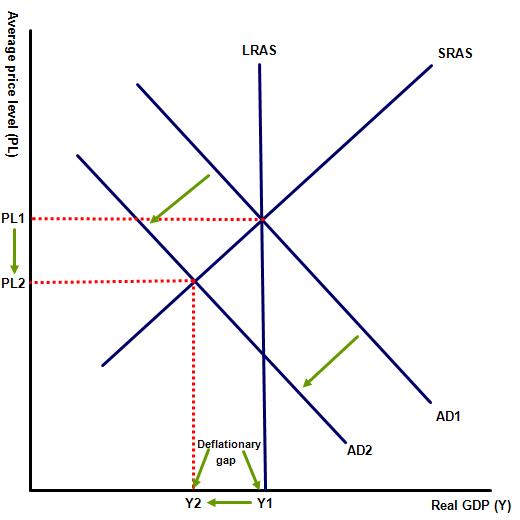 The impact of constraining (contractionary) monetary policy on global economic growth can be shown by the following diagram, with a recessionary gap (or at the very least lower economic growth) resulting from the fall in aggregate demand, as higher interest rates reduce the spending power of businesses and individuals, reducing the level of spending and investment in the economy.
f. Explain using a suitable diagram the impact of the covid-19 pandemic on income inequality (lines 54-55) [4]
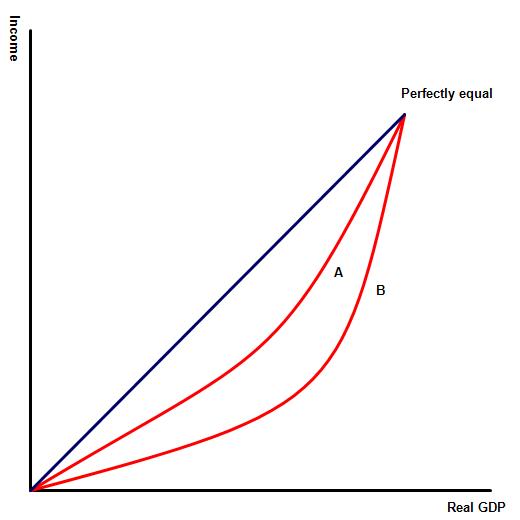 Lines 54-55 of the text suggest that the covid pandemic has worsened the level of income inequality in world economies, raising the gap between the wealthiest and poorest households, shown by a right shift from Lorenz curve A to Lorenz curve B and a higher gini-coefficient.
g. Using the passage and your knowledge of economics evaluate fiscal and monetary policies that economies might employ to erase the scars of the pandemic and return to economic growth. (line 63) [15]
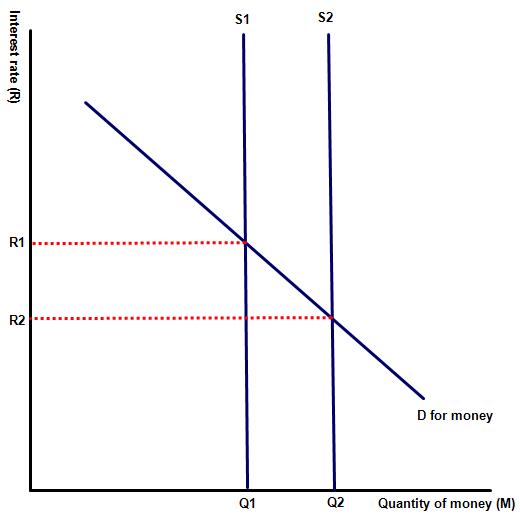
 demand for goods and services, employment, inflation and economic growth. Monetary policy includes the Central Bank using changes in the money supply or interest rates to affect AD.
 consumption and investment that would naturally occur as a result of the initial spur in economic activity. He described this process as the 'multiplier', which can be calculated as the multiple by which any initial fiscal stimulus would be likely to be multiplied by.
.jpg) government borrowing can lead to substantial rises in the real interest rate, absorbing the economy's lending capacity and discourage businesses from making capital investments.
government borrowing can lead to substantial rises in the real interest rate, absorbing the economy's lending capacity and discourage businesses from making capital investments. Twitter
  Facebook
  LinkedIn