


This page covers oligopoly in terms of the nature of the market, collusive and non-collusive oligopoly, game theory, price rigidity, non-price competition and efficiency.
Definition of oligopoly
An oligopoly is a model of a market where a small number of large firms account for a high proportion of total market revenue.
Concentration ratio
The concentration ratio is the percentage of market revenue accounted for by a certain number of films.
Oligopolistic markets have a high concentration ratio which means the largest firms in the market account for a high percentage of total market revenue.
For example, the market for sports clothing and footwear in an economy might be dominated by four large firms. The concentration ratio would be calculated as:
total revenue of the 4 largest firms in a market / total revenue of the market x 100
The annual total revenue figures might be:
$980m / $1210m = 81%
Assumptions of oligopoly
A small number of large firms account for a high proportion of total market revenue. T
Barriers to entry and exit exist in oligopolistic markets. Barriers to entry in oligopolistic markets are similar to those in monopoly markets.
Firms in oligopolistic markets sell differentiated products.
Businesses in oligopolistic markets make interdependent decisions which means they make decisions based on how they believe other firms in the market are going to react to their decisions.
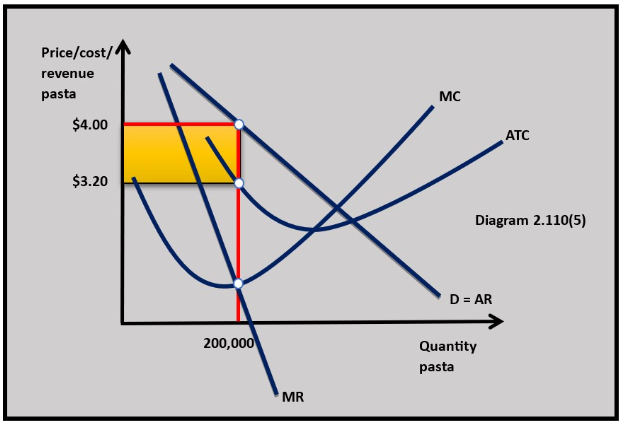 Collusion occurs in a market where firms share information about their price and output decisions.
A cartel is where firms jointly decide to set price and output and by doing this they effectively act as a monopoly.
For example, the pasta market in Italy has been accused of being a cartel with 5 firms collectively agreeing to fix their output and charge the same price.
In diagram 2.110(5) the pasta cartel is earning abnormal profits equal to the yellow-shaded area.
Conditions for collusion
Condition or a collusive oligopoly:
- Firms are located closely together and there are good relationships between the producers.
- A small number of firms are involved in a collusive agreement. When there are too many firms in a cartel it is difficult to control output.
- There are only small differences in the goods sold by individual firms. This means consumers make their buying decisions based on price rather than product quality.
The law and collusion
In most countries, collusive behaviour between firms is illegal because consumers pay a higher price for a lower output than would exist in a competitive market.
Tacit collusion
Firms can use tacit collusion where they make decisions that influence price and output in a collusive way but do not involve a formal agreement.
Tacit collusion can involve price leadership, where firms all change prices together but are led by one firm in the industry.
A non-collusive oligopoly is a market situation where the firms in the market do not enter into any formal agreements with other firms in the industry.
The behaviour of firms in a non-collusive oligopoly can be explained by using game theory.
Game theory
Game theory is a model of strategic behaviour that exists in an oligopolistic market. which explains how businesses react to each other decisions in interdependent decision-making situations.
The strategic element explains how firms plan their pricing decisions in response to their competitors.
Game theory example
This is a game theory example where there are two firms that manufacture and sell pasta in a market and make pricing decisions.
Assumptions of this game theory example are:
- Two firms dominate the pasta market in a duopoly situation – Firm A and Firm B.
- Each firm has an equal market share.
- Each firm has the same costs.
- The products sold by each firm are very similar.
The different decision-making options of each pasta producer in the market are set out in the table.
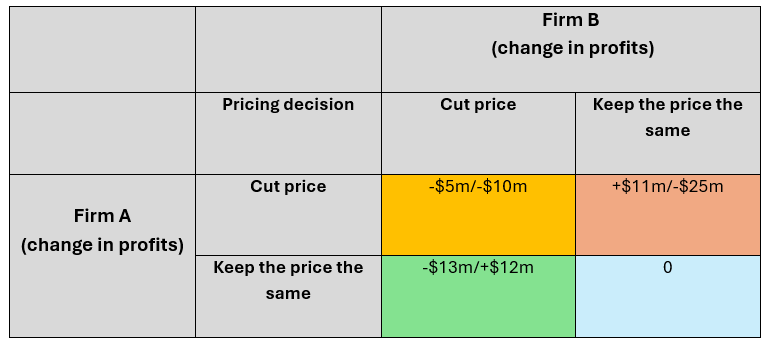
- Given this matrix of outcomes, the least risk for firms A and B to reduce their prices is because this results in the smallest potential loss.
- This game theory example can be used to explain why firms in oligopolistic markets would like to collude and maintain their price at the current level.
Price rigidity
There is evidence that in oligopolistic markets, prices do not change as much as they do in other markets in response to changes in demand and supply.
The theory we have considered so far in oligopoly goes some way to explaining why this might be the case:
- If firms collude in markets and agree not to compete on price.
- Game theory explains how firms' strategic decisions can reduce price changes.
- Businesses in oligopolistic markets want to avoid price war situations.
Non-price competition
Non-price competition is where firms compete with each other on factors other than price.
Firms in oligopolistic markets are reluctant to compete on price so they use non-price competition.
Non-price competition can be used by firms to attract customers in the following ways:
- Improve the quality of their products in the market.
- Promotion and advertising.
- Using a wide distribution network.
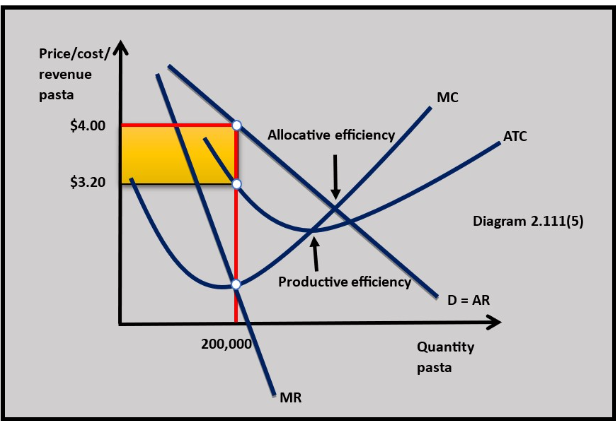
The collusive oligopoly diagram to make judgements about allocative and productive efficiency.
Productive efficiency
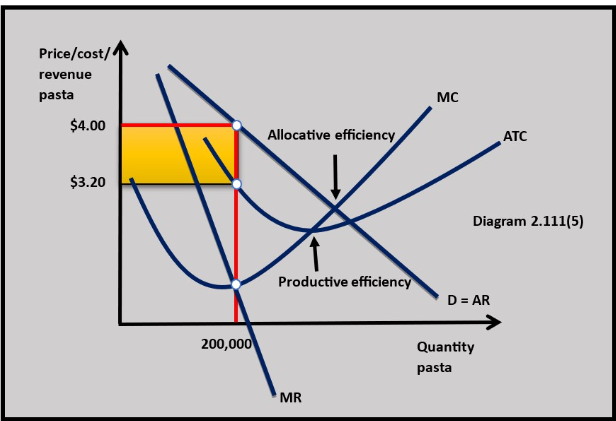
 Oligopolistic firms will not achieve productive efficiency because they do not produce where ATC = MC at the profit-maximising output. This is shown in diagram 2.111(5).
Allocative efficiency
Oligopolistic firms will not achieve allocative efficiency because they do not produce where D = MC at the profit-maximising output. This is shown in diagram 2.111(5).
Oligopolistic markets also have price rigidity. This means prices do not change to reflect changes in relative scarcity in the same way as monopolistic and perfect competition.
Economies of scale
Firms in oligopolistic markets benefit from significant economies of scale which generally makes their prices lower and output higher than in perfect and monopolistically competitive markets.
Barriers to entry
The barriers to entry in oligopolistic markets yield profits that can be re-invested back into the business which gives consumers new products.
Explain how non-price competition can increase the demand for a firm's goods in an oligopolistic market. [10]
 Definitions of non-price competition, demand and oligopoly.
 Twitter
  Facebook
  LinkedIn