


This page covers monopoly in terms of the nature of the market, barriers to entry, price and output, profits and losses and efficiency.
The nature of monopoly
Defining monopoly
A monopoly exists when one firm's output accounts for the total market supply of an industry.
Domestic water supply in an area is an example of a monopoly.
Dominant producer monopoly
Many countries consider firms whose total revenue accounts for a high proportion of total market revenue as having monopoly power.
For example, Facebook's market share of the social media market is 74 per cent.
Barriers to entry exist
Monopolies exist because of barriers to entry that prevent new firms from entering a market to compete with the existing monopoly firm.
A barrier to entry is a restriction and/or cost of setting up in a market that is over and above the normal cost and or restrictions of entering a market.
Examples of barriers to entry:
- Control over resources - When one business owns the land needed to access the resources needed for production.
- Legal restrictions and patents - Where a firm owns a patent or copyright, which prevents other firms from using their technology and production system.
- Technical barriers – When one firm’s product becomes established amongst consumers and is it technically difficult for them to switch to new suppliers.
- Brand loyalty – Once a firm establishes a brand in a market it can develop brand loyalty that makes it difficult for new entrants.
- Advertising and promotion expenditure – Where an existing firm spends large amounts of money on advertising and promotion it is difficult for a new entrant to get their brand known.
- Economies of scale – A problem for any new small firm entering a market is matching the cost structure of a large existing producer in the market that is benefiting from significant economies of scale.
- Fixed costs or set-up costs – The cost of setting up production in some industries is so high that entrants are unable to enter the market.
The demand curve
Where an industry is dominated by a monopoly producer, the firm is considered to be a price maker because there is no competition in the market.
The barriers to entry the monopoly producer benefits from mean there are few close substitutes for the monopoly producer's product. This means the demand curve the monopoly firm faces is downward sloping.
The demand curve is equal to average revenue, but the marginal revenue curve separates from the demand curve.
With a downward-sloping demand curve, the marginal revenue is twice as steep and becomes negative on the price inelastic section of the demand curve. This is shown in diagram 2.110(3).
The table sets out price and revenue data for a monopoly producer in the domestic water market.
| Price | Quantity '000' | Total revenue '000' | Average revenue | Marginal revenue |
| 500 | 200 | 100,000 | 500 | |
| 450 | 250 | 112,500 | 450 | 250 |
| 400 | 300 | 120,000 | 400 | 150 |
| 350 | 350 | 122,500 | 350 | 50 |
| 300 | 400 | 120,000 | 300 | -50 |

Profit maximisation
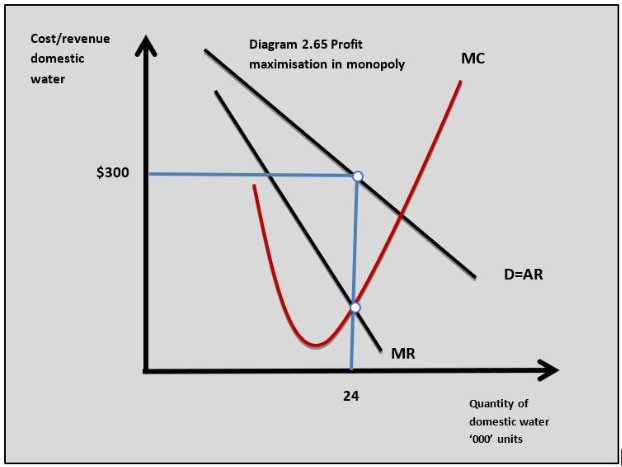
Monopoly firms aim to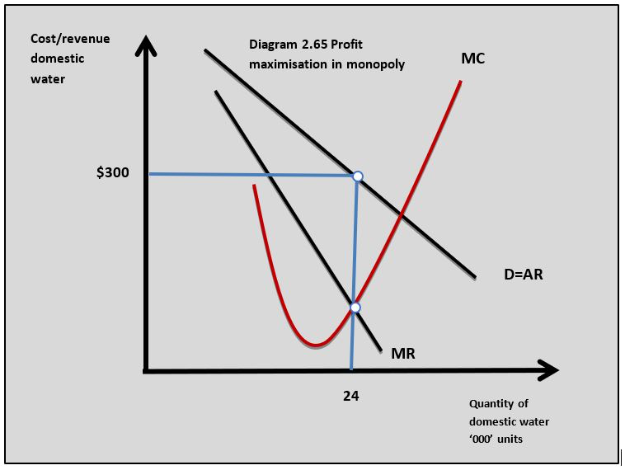 profit maximise by producing where marginal cost equals marginal revenue when marginal cost is rising.
At the profit-maximising output, the monopolist sets a price based on the demand curve at that level of output.
The profit-maximising output for the monopoly water business is shown in diagram 2.111(3).
Normal profit
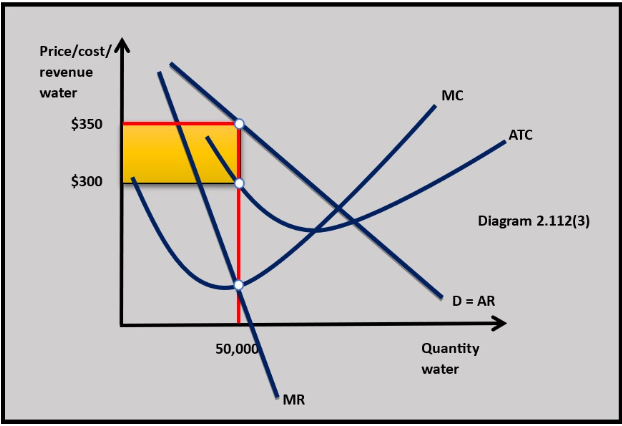
When a monopoly producer earns normal profit it produces where total revenue equals total cost or average revenue equals average total cost at the profit-maximising output.
This is the minimum level of profit the firm needs to achieve to maintain its operations in the market.
Normal profit in the monopoly water business is shown in diagram 2.111(3).
Abnormal profits
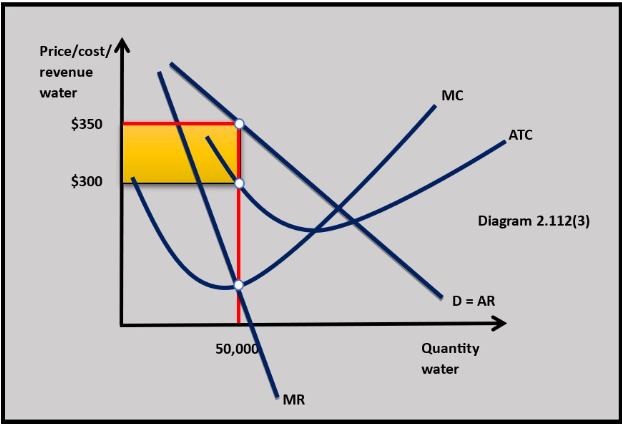 When the monopolist is making abnormal profit the business is earning more profit than the minimum needed to keep producing in the market.
A monopoly firm earns abnormal profits when total revenue is greater than total cost. This can be calculated in the diagrams as:
(AR – ATC) x Q
In diagram 2.112(3) this can be calculated as:
($450 - $400) x 250,000 = $12,500,000
The barriers to entry in a monopoly market mean the monopolist can earn abnormal profit in the long run.
Losses
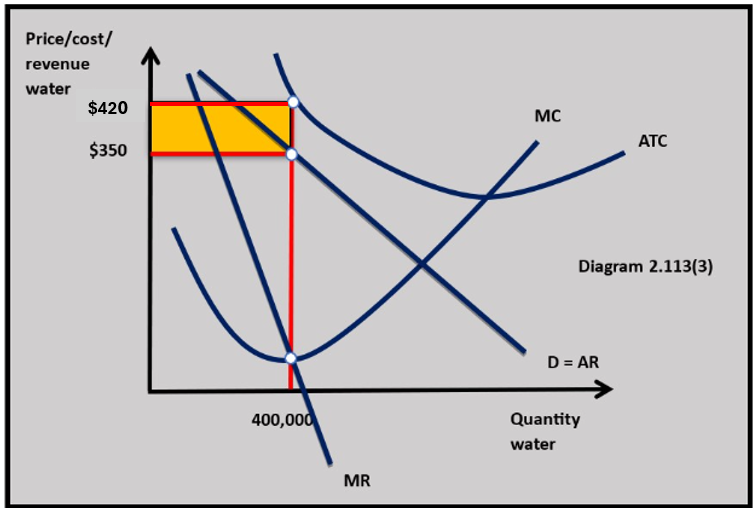 When the monopolist is making a loss the business is earning less profit than the minimum they need to keep producing in the market.
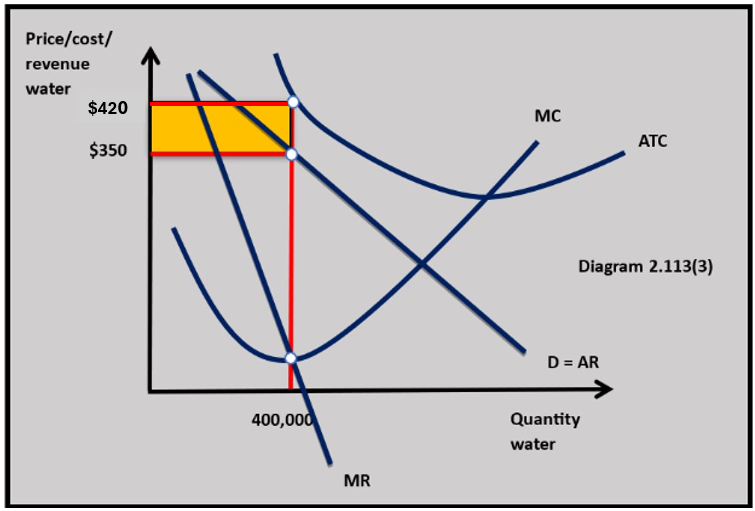
Monopoly firms can make losses when the total cost is greater than total revenue.
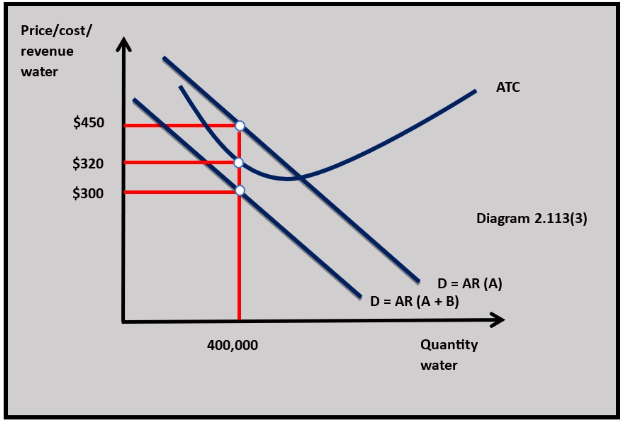
Losses can be calculated in diagram 2.113(3) as:
(ATC – AR) x Q
($300 - $350) x 400,000 = $20,000,000 loss
A loss can be sustained by the monopolist in the short run, but in long run, it will need to shut down unless it can either reduce its costs or increase revenues.
Definition
A natural monopoly is a market that will tend to exist as a monopoly because the market cannot sustain more than one producer.
Reasons for natural monopoly
- Significant economies of scale in the industry
- Very high fixed costs or set-up costs
- The market is only large enough to support one producer
Natural monopoly often occurs in so-called ‘utilities’ such as gas, electricity and water.
Example of a natural monopoly
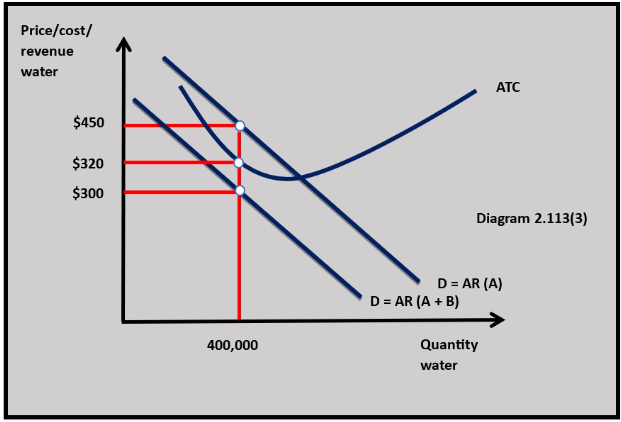 Diagram 2.114(3) shows the domestic water market as a monopoly with firm A the single producer in the market.
The profit maximising price is set at $450 per year with 400,000 customers and the firm will make an abnormal profit.
When firm B enters the market, the demand curve falls to D = AR (A+B), and the price falls to $300, which leads to losses.
This means only one firm will be able to make enough profit to maintain its position in the market.
Productive efficiency
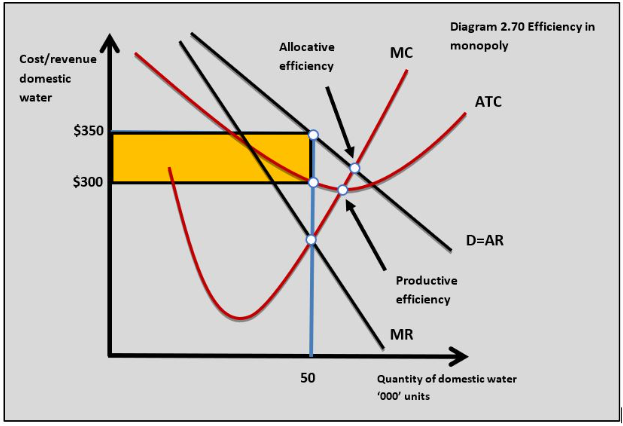
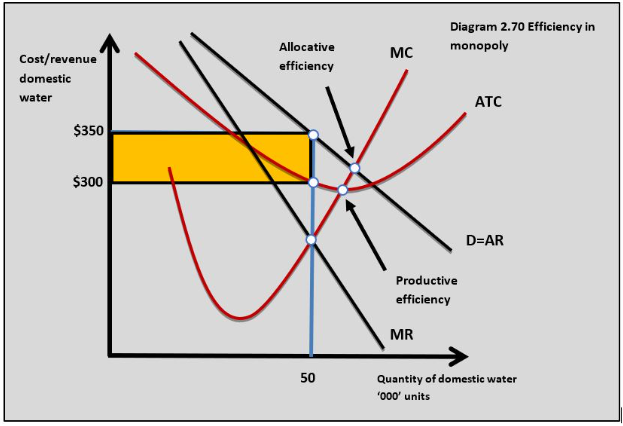 Monopoly firms will not achieve productive efficiency because they produce on the downward-sloping portion of the ATC curve and do not achieve the lowest ATC. This is shown in diagram 2.114(3).
The lack of competition means monopoly firms do not have the incentive to produce efficiently.
Allocative efficiency
Monopoly firms will not achieve allocative efficiency because the price they charge is above MC. This is shown in diagram 2.114(3)
The consumer and producer surplus in the market is not maximised. This is shown in diagram 2.114(3)
The yellow-shaded area is the loss of consumer surplus which is not gained by the monopoly producer and is called the consumer welfare loss. This is shown in diagram 2.114(3)
The green-shaded area is the welfare loss of producer surplus of producers not in the market because of barriers to entry. This is shown in diagram 2.114(3)
The consumer deadweight loss and producer deadweight loss equals the total welfare loss.
Economies of scale
Because monopolies are often large firms they tend to benefit from economies of scale which allow them to produce at a higher output and a lower price than firms in perfect competition.
Innovation
Because monopolies can sustain abnormal profits in the long run it has the incentive and the resources to invest in new and better products and systems.
Abnormal profit also provides the funds needed to develop new products and systems.
Using a real-world example, evaluate the view that a monopoly will always be bad for consumers. [15]

 Twitter
  Facebook
  LinkedIn