

Question 1: Unit 4.7-4.10 Development
(a) Illustrate the impact of higher oil prices on a developing nation. [10 marks]
How to write this part (a) response:
Introduction
Define the economics terms used in the first part of the essay - developing nation
Main Body
Using an appropriate diagram and specialist terminology show the impact of higher oil prices on the AS/AD of a non-oil producing developing nation.
Using an appropriate diagram and specialist terminology show the impact of higher oil prices on the AD of an oil producing developing nation.
Conclusion
Concise summary, consistent with the main body (do not add any new information in the conclusion)
Click on the arrow to view my exemplar response
Command term: Illustrate
A developing nation can be described as one where the average income and HDI is lower than in industrial nations, where the economy has an over reliance on a few export crops and a embryonic industrial sector. [Key concept].
 In answering this question, illustrating the impact of higher oil prices on a developing nation, we need to divide developing nations into those that import large qualities of the commodity and oil exporting LEDCs e.g. Nigeria and some other African nations. [Structure of the essay established].
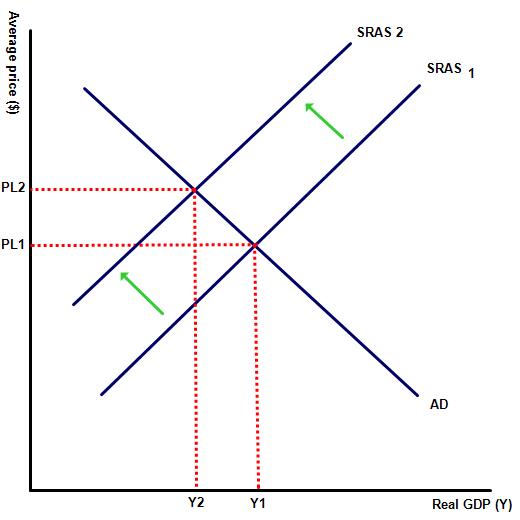
Turning to oil importing nations first, the impact of any rise in the price of oil will be negative in terms of its impact on all of the macroeconomic objectives. Diagram one illustrates the effect of higher oil prices on the macro economy of an oil importing developing nation. [Application and diagram explained]. Any nation that has to import oil will see a rise in production costs, when oil prices increase, shown on the diagram by a fall in SRAS from SRAS1 to SRAS2. [Diagram explained]. This is sometimes referred to as a supply shock and brings about a significant increase in cost-push inflation. [Analysis]. This effect would, of course, be replicated in many fully developed nations reliant on oil imports but the negative effects on any developing country will be more extreme. Unlike many developing countries that gain a large share of their national wealth and export revenues from the tertiary and quaternary sectors which are less reliant on oil, developing nations, particularly those in the process of industrialisation are likely to earn almost all of their income from the primary and secondary sectors, that are heavily reliant on oil. [Analysis]. Furthermore, developing nations are less likely than developed ones to have diversified their energy reliance, away from oil and towards alternative energy sources, such as natural gas or renewable sources. [Analysis]. The impact of the above is illustrated on the diagram by a rise in average prices as fall in national income. [Diagram explained].
Another impact on non oil-producing nations is on the current account. With the nation having to spend more on oil 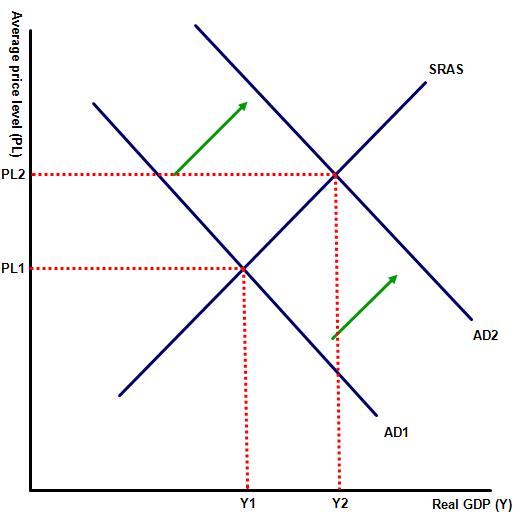 imports (remembering that oil has a low PED elasticity), the nation then has fewer resources to purchase the imported capital machinery and luxury consumer goods that the developing nation is used to purchasing, reducing aggregate demand levels through falls in consumption, investment and net exports. [Analysis].
For a developing nation that produces oil the impact could not be more different. [Second part of the essay introduced]. For developing nations such as Nigeria, Angola, Barbados or Venezuela the rise in oil prices has a positive impact on the economy, shown in diagram 2. [Diagram explained]. With oil PED inelastic those nations producing the commodity will see a rise in revenues and for some developing nations this can have a dramatic effect on the nation's finances. [Application]. For example, oil contributes close to 90% of export revenues and around 70% of government revenues for nations such as Nigeria and Venezuela. [Example and analysis]. Those nations are likely to see a spike in all components of aggregate demand, with particular improvement in the current account balance. [Analysis]. For those nations the governments are also likely to see a significant improvement in the budget and this will allow those governments to increase spending on transfer payments and public services, resulting in an improvement in the quality of life for their citizens. [Analysis].
In conclusion, therefore, given the importance of oil to developing nations, whether as importers or exporters of the product, any rise in the price of oil can have a significant impact on the macro economies of each economy with the total effect (positive or negative) depending on whether they area producer or purchaser of oil and the dependence that the economy has on the commodity. [Summary conclusion].
Key terms used: developing nation, HDI, oil exporting, oil importing, supply shock, cost-push inflation, current account, supply shock.
(b) Economic growth will lead to economic development. Using real-world examples evaluate the merits of this view. [15 marks]
How to write this part (b) response:
Introduction
Define the economics terms not used in the first part of the essay - persistent current account deficit, economic growth
Main Body
Using accurate specialised terminology and a suitable diagram explain how economic growth might enable more economic development.
Using accurate specialised terminology and a suitable diagram explain situations where economic growth might not enable more economic development.
Using accurate specialised terminology and a suitable diagram explain the opposing argument, that economic development might enable more economic growth.
Demonstrate a balanced approach both in support of and the arguments against whether an improvement in economic growth is likely to lead to a rise in economic development, or not?
Use real life examples, fixed to the command term.
Conclusion
Concise summary, consistent with the main body (do not add any new information in the conclusion)
Click on the arrow to view my exemplar response
Command term: Evaluate
Economic growth means an increase in real national income / national output. Economic development means an improvement in the quality of life and in living standards, e.g. measures of literacy, life-expectancy and health care. [Key terms defined]. Whether ceteris paribus, we would expect economic growth to enable more economic development will be explored during this essay. [Introductory sentence].
One strong argument in support of the statement is that Increased levels of income could translate to higher levels of consumption of goods and services by society. [Application]. This could lead to more choice, more food consumed and better shelter opportunities. [Analysis]. Equally, government investment in better health facilities will improve the longevity of the population, government investment in more educational opportunities will improve the literacy of the population and have positive externalities for society. [Evaluation].
Economists argue that economic growth is effective at improving economic development through poverty reduction, particularly in the developing world. [Application]. Economic growth reduces poverty because growth has little impact on income inequality, with the distribution on income relatively stable over time. This means that economic growth tends to raise incomes for all members of society, including the poorest. [Analysis]. This is particularly true of absolute poverty rates. For example the last twenty years have witnessed very large falls in absolute poverty, particularly in the world's two most populous nations China and India. [Real-world example]. At the same time both countries have enjoyed very high rates of economic growth that have facilitated this process. [Evaluation].
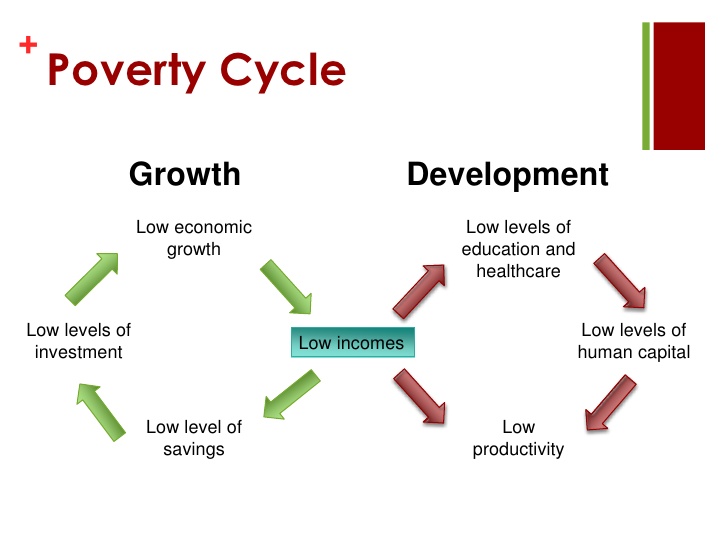 The Harrod Domar model of development also suggests that increased per capita GDP/GNI provides households and businesses with greater financial resources to save. This in turn ends up in banks and can then be lent out to businesses/households. [Analysis]. According to this model developing nations might use higher savings rates to break their current cycle of poverty. [Evaluation]. As the diagram illustrates the low level of national income in the nation means that almost all of a person's income is consumed, leading to very low levels of saving. This means that banks lack the deposits required to lend out to businesses, resulting in a very low level of capital per worker. For example, in developed nations it is not uncommon to see a lot of work completed by machinery with perhaps a handful of accompanying workers. In developing the same tasks are completed by a large team of workers, instead, reducing the output per worker of the job. [Evaluation].
Increased employment is another benefit of economic growth with a larger economy leading to the creation of new jobs, which in turn provide a flow of incomes for people in work. As each person enters employment they increase their own spending on goods and services, as well as saving a proportion of their new income, which creates a ripple effect throughout the economy. Keynesian economists call this the multiplier effect as any additional income multiplies as it ripples through the economy. [Evaluation].
Faster economic growth also generates higher profits which can then be reinvested – promoting increased productivity and capacity, accelerating changes in patterns of production e.g. a shift away from a dual economy towards investment in manufacturing and services such as business services and tourism. [Analysis].
Finally economic growth generates higher tax revenues for the government, providing more funds to finance public and merit goods, welfare spending and public services such as education and healthcare services. These in turn bring about improvements in literacy rates and life expectancy. In doing so a nation can improve all three elements of its human development index - GNI per capita, life expectancy and years of schooling. [Evaluation].
So is the notion that economic growth will lead to economic development accepted by all development economists, well not entirely? [Counter arguments established].
One reason for this is that while the correlation between economic growth and development is well established, some economists argue that it is not economic growth that creates high development but instead higher development than creates economic growth. [Analysis]. For example, while economists can point to provable correlations between the two variables this does not prove which way round the two things happened. Was it rises in economic activity that led to higher spending on education, healthcare and better infrastructure, or was it increased spending on education, healthcare and better infrastructure that created the conditions for greater economic output? [Evaluation]. Furthermore, empirical evidence offers us no more clues, for instance a look at nations that have grown very quickly over the last three decades - China, India and Malaysia demonstrates a familiar pattern. Nations that at the same time as rapid strides in economic growth were made also saw significant falls in absolute poverty rates and improvements in their human development index. This is because at the same time as those economies grew, resources were poured into education and healthcare and so living standards grew. [Real-world examples]. What the above does not tell us, of course, is which came first? Did the increased tax revenues, generated by economic growth allow the governments of those nations to divert resources into public services, or did the public sector improvements create a healthier, more productive workforce, which in turn raised economic output? [Evaluation].
While the three nations described above highlight nations that have been successful in raising both living standards and national income, others have been less successful and this sometimes occurs when a nation's sudden increase in GDP comes from the discovery of large energy or rare mineral deposits. Examples of this include Mongolia (rare earths), as well as some west African countries, whose GDP growth has been driven by large oil deposits. [Real-world example]. In each case the rewards of economic growth are enjoyed only by an elite group of politically connected individuals. When this happens then it is unlikely that the growth will be sustainable and may not have any lasting bearing on development. For example, despite its comparative recent affluence poverty rates and human development index remain below some other comparable nations e.g. Rwanda with much lower GDP per capita, but whose governments have made great strides in both improved literacy rates and life expectancy as well as lower poverty levels. [Evaluation].
Finally, it is important to realise that there are, or at least there can be disadvantages resulting from economic growth i.e. economic and social costs. [Final counter argument established]. Visitors or even more resident of the three nations identified above will recognise some of the negative consequences of growth, including very high levels of pollution in cities - almost all of the worlds most polluted environments, cities where the air quality falls short of the world health organisations recommended safe levels exist in those nations, as well as a small number of other fast growing developing economies. [Real-world example]. Equally, opponents of the Brazilian government are quick to highlight that much of that nation's recent economic growth has come from environmental damage such as soil erosion and desertification, as large areas of the Amazon have been cleared for farming. [Real-world example].
In conclusion, therefore, it is not automatic that higher rates of economic activity will cause higher levels of development but the two indicators often go hand in hand. Growth is probably a necessary but insufficient condition for sustained human development – it can underpin gains in health, education and per capita incomes but many other factors also determine the development process. [Summary conclusion].
Key terms used: economic growth, human development, Harrod-Domar model of development, poverty reduction, absolute poverty, externalities, poverty cycle, multiplier, savings rate
Feedback
Which of the following best describes your feedback?
 Twitter
  Facebook
  LinkedIn