Define the economics terms not used in the first part of the essay - exchange rate
Using accurate specialised terminology and a suitable diagram illustrate inflation and deflation.
Using accurate specialised terminology and an appropriate diagram, show and explain how a nation's government or central bank can intervene in the foreign exchange market to devalue its currency (deliberately).
Using accurate specialised terminology and an appropriate diagram, show and explain how a weaker currency may benefit some nations by improving its net exports.
Using accurate specialised terminology and an appropriate diagram, show and explain how a weaker currency may not improve its net exports and also worsen other macroeconomic indicators, especially inflation.
Demonstrate a balanced approach both in support of and against the arguments against the use of intervention in the foreign exchange market to devalue a currency.
Use real life examples, ideally from your own country, fixed to the command term.
Concise summary, consistent with the main body (do not add any new information in the conclusion)
Command term: Evaluate
A nation's exchange rate (currency) represents the price of one currency relative to another. [Key term]. The price of a nation's currency is determined, like all commodities, by its supply and demand. [Application]. The supply 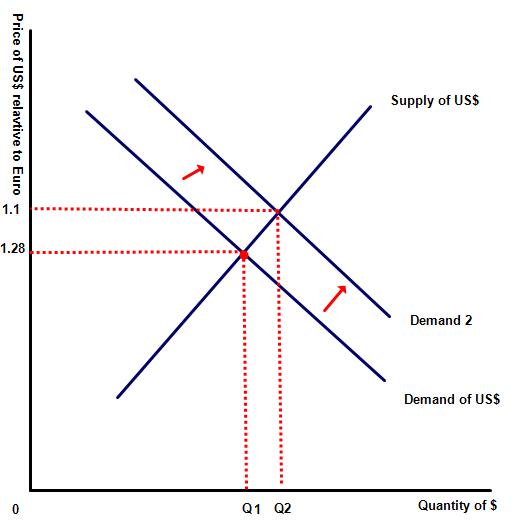 of a currency comes from domestic citizens, institutions and government who supply the currency, exchanging it for foreign currencies to purchase goods and services produced overseas (imports). For example, diagram one illustrates an appreciation of a currency (US$) as a result of a rise in demand on international foreign markets. [Analysis with diagram].
Some of the methods that a government or central bank might employ to reduce the value of a nation's currency include lowering interest rates and open market operations, using their own reserves of currency to purchase foreign ones, raising demand for the foreign currency, while raising the supply of their own. [Analysis]. Equally, the government or central bank could lower interest rates to have the same effect. For example, if a country reduces interest rates rise relative to others, it will become less attractive to deposit money because investors (overseas or domestic) will receive a lower rate of return from savings. [Analysis].
So now we can turn to the second part of the question, why would a government do this, why would they wish to devalue their currency? [Application]. The answer is to increase export competitiveness and encourage greater demand for exports, which may rise if the exchange rate is lowered, to protect employment/increase employment. [Evaluation].
Secondly, to help export producing industries to stay in business, perhaps even expand their production, to protect employment and reduce import expenditure and/or to correct a current account deficit or increase further a current account surplus. This will of course depend on the elasticity of demand for exports and imports - Marshall-Lerner condition. [Evaluation].
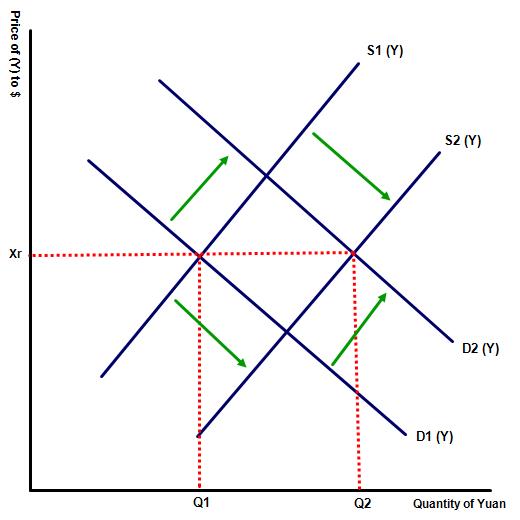 China is an example of a nation that is sometimes accused of adopting such a policy and if true, it is not difficult to understand why? China is a developing nation with a large secondary sector that has grown very rapidly in recent decades. In large part this is a result of their ability to export manufactured goods to other nations. [Application]. Part of this strategy includes maintaining its currency (the Chinese Yuan) within an agreed budget. [Analysis]. This is illustrated by diagram two, illustrating direct intervention by the Chinese central bank. In the diagram, the bank has directly intervened in the currency market, purchasing $s to stabilise its own currency after a rise in demand for Yuan shown by D1 (Y) to D2 (Y). [Analysis].
By undertaking this policy the Chinese government is hoping to improve its net exports, one of the components of aggregate demand. [Evaluation].
On the other hand, the action is not without its criticisms, which explains why direct action of this kind is not applied universally by governments. [Counter arguments introduced].
The first of these is the potential threat of retaliatory action, from other nations. A country could find that the gains on the current account from reduced imports are more than matched by losses of exports as a result of retaliation. [Counter argument identified]. For example, China has intermittently faced retaliatory measures by the EU and USA (particularly during Donald Trump's presidency) and this policy of retaliation has been supported by the general public in those nations. [Analysis and real-world example].
A second down-side to any action is that while a cheaper currency may be good for a country's net exports, it is less good news for inflation, with higher import prices resulting in greater cost push inflationary pressures. This would apply to higher prices of imported raw materials and finished products creating inflationary pressures. [Analysis].
Thirdly, if a nation devalues its currency in the hope of improving its current account balance then this will only happen if the combined PED of both imports and exports is greater than 1. In other words if the improved competitiveness of a firm's products leads to a greater than proportional change in products traded. [Evaluation]. Even if this is the case, i.e. when the Marshall-Lerner condition is satisfied it is still likely that the current account balance will deteriorate before it improves, as in the short run demand for imports and exports is inelastic and so the lower value of the exchange rate is more likely to worsen the current account balance than improve it. [Analysis].
In conclusion, therefore, the argument as to whether an economy benefits, in terms of an improvement in net exports, following a devaluation is questionable. However, some governments believe this to be the case and for this reason implement different monetary policy instruments in order to weaken their national currency and gain benefit from doing so. [Summary conclusion].
Key terms used: demand and supply for a national currency, foreign exchange market intervention, net exports, aggregate demand, current account deficit/surplus, Marshall-Lerner condition, inflation


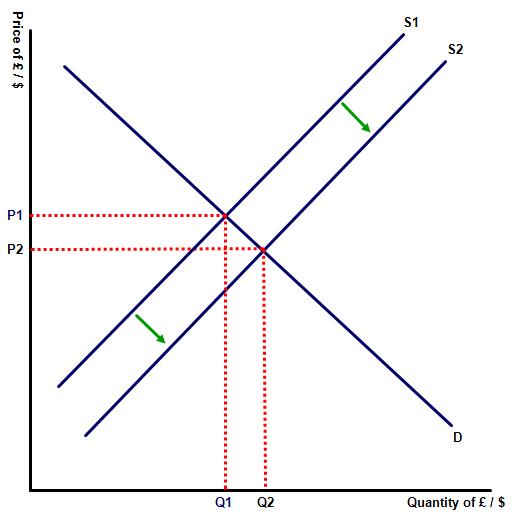 A nation's exchange rate (currency) represents the price of one currency relative to another.
 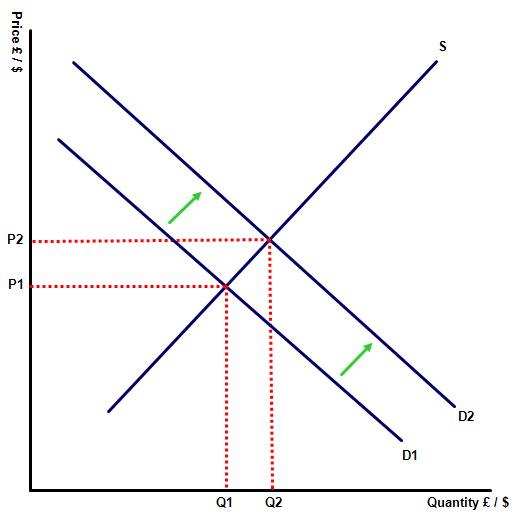 competitive, and there will be an increase in demand for £ to buy UK goods. (shown on diagram two) Additionally, foreign goods will be less competitive and so UK citizens will buy fewer imports, reducing the supply of £s on world markets.
  Twitter
  Facebook
  LinkedIn