


This page covers the theory of common pool resources, the importance of sustainability, external costs and policy approaches to common pool resources.
Definition of a common pool resource
Common pool resources are the natural resources that firms and individuals can access in society without restriction.
Common pool applies to resources like forests for timber, the sea for fish and areas of land for mineral deposits.
Common pool resources are associated with two characteristics:
- Non-excludable because they occur naturally in the environment, and without government intervention, it is impossible to limit access to them.
- Common pool resources are rivalrous because the consumption of them by one individual does reduce their availability to others.
Property rights
Property rights exist when an individual or a firm has ownership of a resource. When a farmer owns a field they have property rights over that field and have the legal right to control its use.
Common pool resources do not have property rights assigned to them and nobody owns them. For example, there are no property rights on the open sea.
Sustainability
This is where the use of resources in the economy meets the needs of the present generation without adversely affecting the needs of future generations.
Unsustainable economic activity is often associated with the over-consumption of common pool resources which reduces their availability to people in future.
Non-excludability and zero price
The non-excludable nature of common pool resources means there is no price attached to their consumption and use in production.
Zero price leads to the unsustainable use/consumption of common pool resources.
For example, where an area of land can be freely accessed to cut down trees, people will clear a forest in an unrestricted way until significant deforestation has taken place.
External costs
When common pool resources are over-consumed there will often be external costs. Deforestation negatively affects third parties because it adds to climate change and reduces biodiversity.
The externality argument can also be used when the use of common access resources now reduces their availability to future generations.
Overfishing now means fish will not be available to people in the future who would be considered a third party.
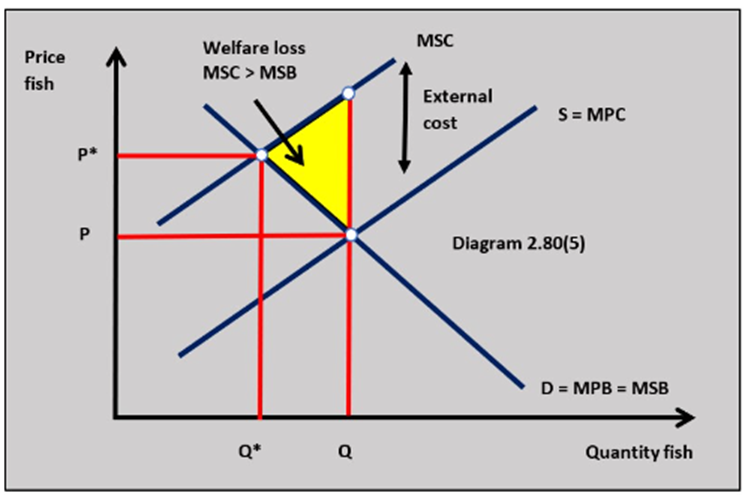
.jpg) Diagram 2.80(5) illustrates the external costs of overfishing the sea. The market output Q is above the socially efficient output of Q*.
Diagram 2.80(5) illustrates the external costs of overfishing the sea. The market output Q is above the socially efficient output of Q*.
There is an over-allocation of resources and the yellow-shaded area represents the welfare loss to society.
Developing countries
The exploitation of common pool resources often takes place in less developed countries where property rights are not established effectively.
People in poverty are often forced to exploit cheap resources available to them.
Tragedy of the commons
The theory argues that the use of common pool resources leads to a ‘shared-resource system’ where people over-produce goods using common pool resources.
Assigning property rights
By assigning property rights to a forest people who cut down trees have to pay the owner of the forest who can use the income to plant new trees.
The owner of the property rights to the forest can make their use sustainable.
Advantages of property rights:
- By allocating property rights common pool resources now have owners and can be made excludable.
- Owners of common pool resources have the incentive to manage them sustainably.
- It is a low-cost way of dealing with the common pool resource problem.
Disadvantages of property rights:
- The owner might not have social efficiency as an objective of owning a common pool resource.
- Some common pool resources can be areas of natural beauty that society (rather than the owner) wants to be maintained in a particular way.
- The legal costs associated with the resolution of property rights disputes.
- It is not always practical to assign property rights such as the oceans.
Command-and-control regulation
Command-and-control regulation is where the government sets specific limits on environmental pollution.
The regulations set out how technology can be used to control pollution.
For example, the US has government-imposed regulations on power plants to use cleaning technology in their smokestacks that removed pollutants.
Advantages of command and control regulation
- The law forces firms to take action to reduce the negative externalities of production that occur with the exploitation of common pool resources
- It is a set of regulations that form a national framework that reduces environmental costs.
- Regulations can induce firms to develop technology that allows them to meet the regulations set (Porter Hypothesis).
Disadvantages of command and control regulation
- No incentives for businesses to improve the quality of the environment beyond the standard set by the law.
- Regulation can increase production costs which could cause unemployment and lead to higher prices for consumers.
Collective self-governance
This is where local people work together to solve the environmental costs associated with the common pool resources rather than government regulations.
An example of self-governance is Maine’s fishing community in the US.
Advantages of collective self-governance
- Local communities know and understand the specific issues they face from common pool resources.
- Collective agreements are more flexible than national regulations.
Disadvantages of collective self-governance
- The enforcement of rules relating to common pool resources relies on the goodwill of participants.
- The approach might take a short-term view and not be sustainable.
- Many common pool resource issues are global and cannot be effectively managed at a local level.
Carbon tax
Carbon taxes focus precisely on one of the most significant causes of climate change by directly trying to reduce CO2 emissions from the use of fossil fuels.
 The tax is levied on firms based on the amount of carbon they use to produce their goods or service.
The tax aims to get businesses and consumers to switch to energy generated by renewable sources such as solar and wind power.
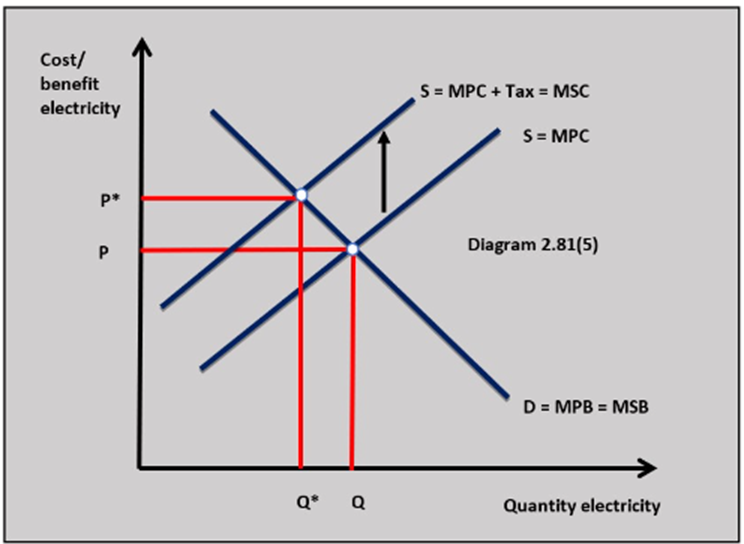
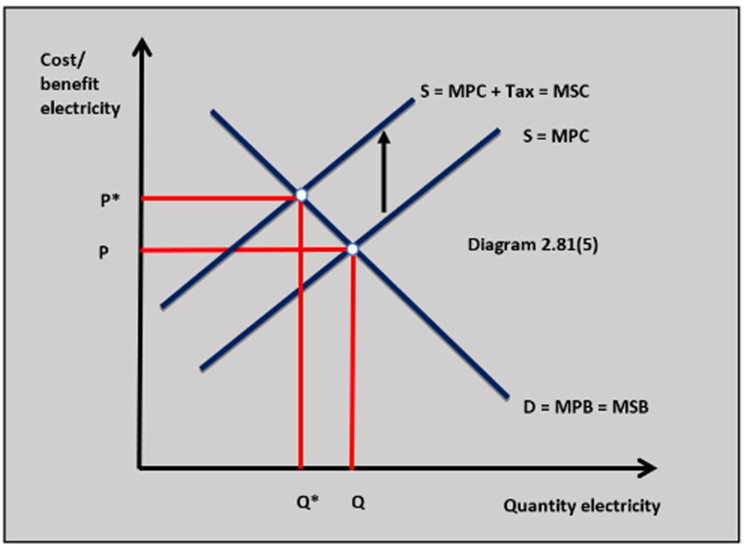
 Diagram 2.81(5) illustrates how a carbon tax affects the market for electricity.
The tax causes the supply curve to shift to the left and causes the market price to rise to P1 and output Q to shift to the socially efficient output at Q*.
Advantages of a carbon tax
- The tax focuses on a major source of climate change and acts as an incentive for firms to switch to renewable sources of energy.
- Revenue raised by the tax can be used to subsidise innovation in the development of renewable energy.
Disadvantages of a carbon tax
- A tax will increase the price of energy to consumers if producers pass on the tax increase.
- As business costs are increased by the tax it reduces their profits and leaves businesses with less money to invest in developing low-emission technology.
- Higher production costs resulting from the tax could cause unemployment.
Explain how common pool resources are an example of market failure. [10]
 Definitions of common pool resources and market failure.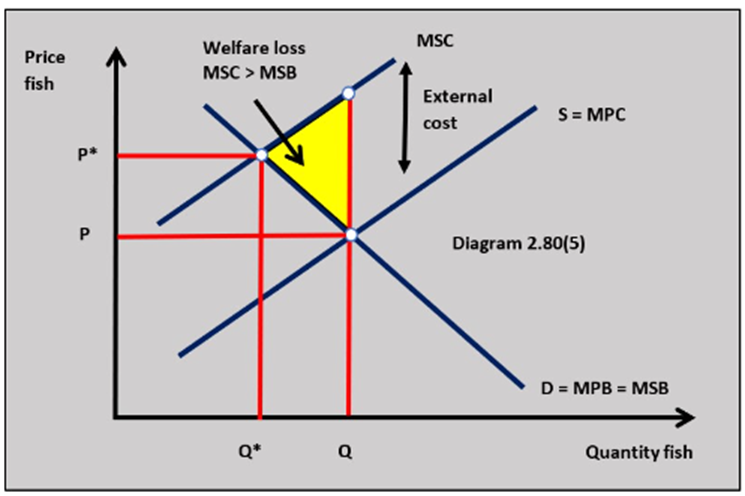
 Twitter
  Facebook
  LinkedIn