


This page covers the policies to increase the consumption and production of goods associated with positive externalities and merit goods. These policies include subsidies, state provision, regulation, advertising and education.
Subsidies on external benefits of consumption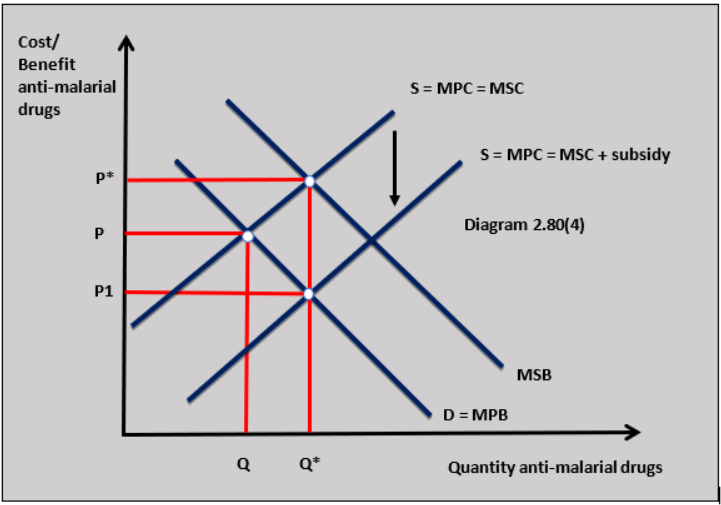
When positive externalities exist in a market the government aims to increase market output to the socially optimum level.
The payment of a subsidy provides a financial incentive for producers to increase output, and consumers to increase consumption of a good associated with positive externalities.
For example, governments subsidise anti-malarial drugs to make them more affordable in developing countries.
Diagram 2.80(4) shows the impact of the subsidy on anti-malarial drugs. When the subsidy is added by the government the price falls from P to P1 and output rises to the socially efficient level at Q* and welfare is gained.
Subsidies on production external benefits
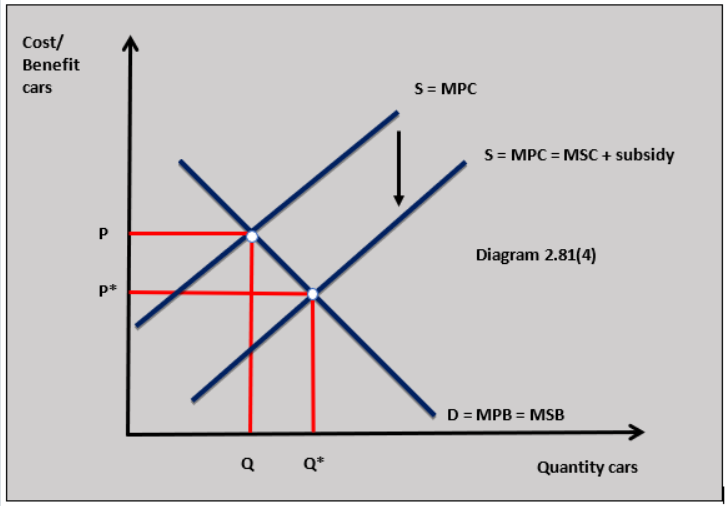 Subsidies are often paid to firms who locate in areas of industrial decline because the positive externalities of their location help to stimulate regional economic growth.
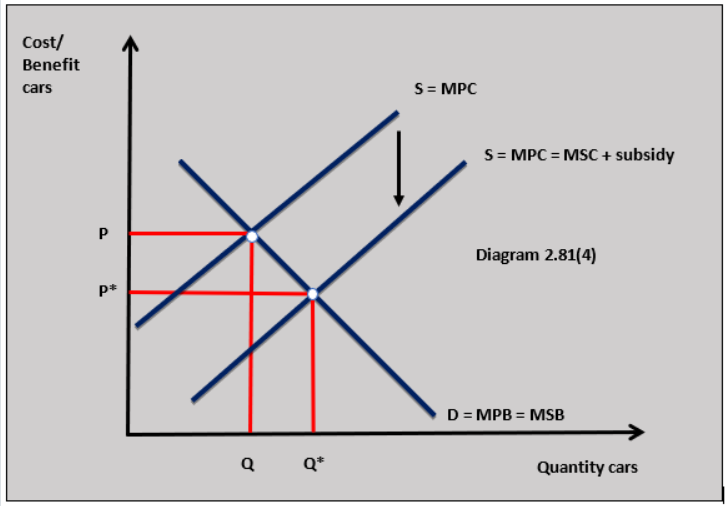
Diagram 2.81(4) illustrates the effect of a subsidy paid to a car manufacturer located in an area that has suffered from significant industrial decline. The price falls from P to P* and output increases to the socially efficient output at Q*.
Advantages of subsidies:
- Subsidies create direct financial incentives that will increase output and capture the welfare gain from external benefits.
- Low-income consumers benefit from lower-priced goods.
- Producers will be encouraged to increase output which creates employment.
Disadvantages of subsidies:
- The opportunity cost to the government in terms of other public services they could have financed.
- Subsidies are often paid to high-income groups.
- Subsidies can lead to a welfare loss where inefficient producers are drawn into the market.
Definition of state provision
Governments choose to take the provision of merit goods and other goods associated with significant positive externalities into the public sector and provide the goods themselves.
This is particularly true in the healthcare and education markets.
Advantages of state provision:
- It is the most direct way of increasing output towards the socially efficient level.
- The state is more likely than the private sector to make decisions in the public interest.
- Goods can be provided at the price (or zero price) that all households can afford.
Disadvantages of state provision:
- The cost of providing state-run healthcare and education is a significant opportunity cost to the government.
- The state may be less efficient than private-sector provision.
- State-run organisations are often subject to political interference.
Governments believe that the consumption of some goods is so important that the government forces people to consume them.
This is particularly the case with primary and secondary school education.
Advantages of regulation:
- Laws force individuals and businesses to make decisions that achieve the socially efficient level.
- Regulations can be targeted precisely at goods and services.
Disadvantages of regulations:
- Costs of policing and enforcing regulations.
- Regulations add to business costs.
- Some businesses and individuals avoid the regulations.
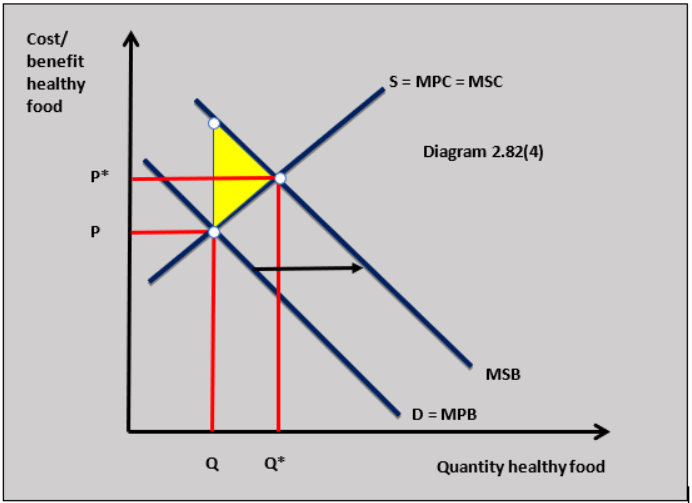 Governments can try to increase the demand for goods associated with positive externalities to move production and consumption towards the socially efficient level of output.
For example, the state can fund the advertising of things like further education, healthy eating and exercise.
Educational programmes to increase the demand for merit goods such as vaccination programmes.
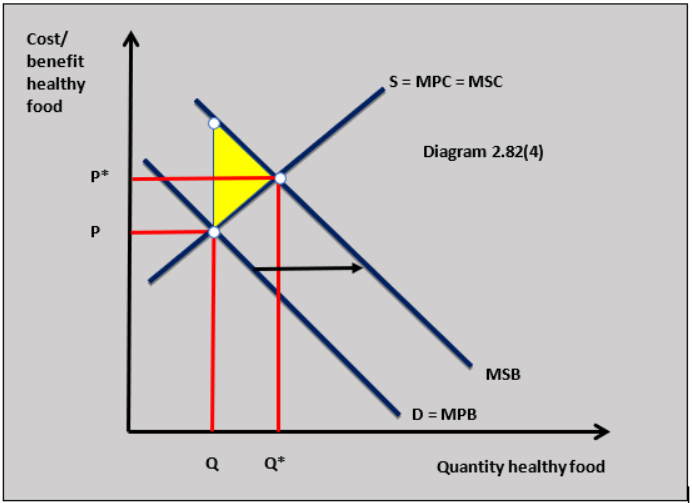
 Diagram 2.82(4) illustrates the impact of a government advertising campaign to increase the consumption of healthy food as part of a healthy living policy.
Advantages of increasing demand:
- Education and advertising are not as expensive as using subsidies and do not have the management problems of regulation
- It is effective in altering human behaviour, which is an effective long-run solution.
Disadvantages of increasing demand:
- The opportunity cost to the government of funding advertising and educational programmes.
- It is not easy to measure the effectiveness of advertising and educational programmes.
Using a real-world example, evaluate the view that subsidies are the best way to make healthy food affordable to low-income households. [15]

 Twitter
  Facebook
  LinkedIn