


This page covers the different policies to reduce the external costs of consumption and production. This includes taxation, tradeable permits, regulations, advertising and education.
Tax on production external costs
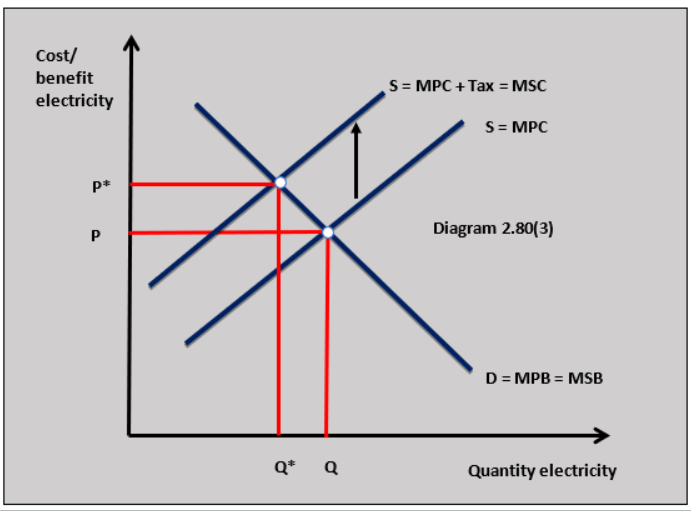 Where an industry is associated with negative externalities, governments can impose indirect taxes on producers.
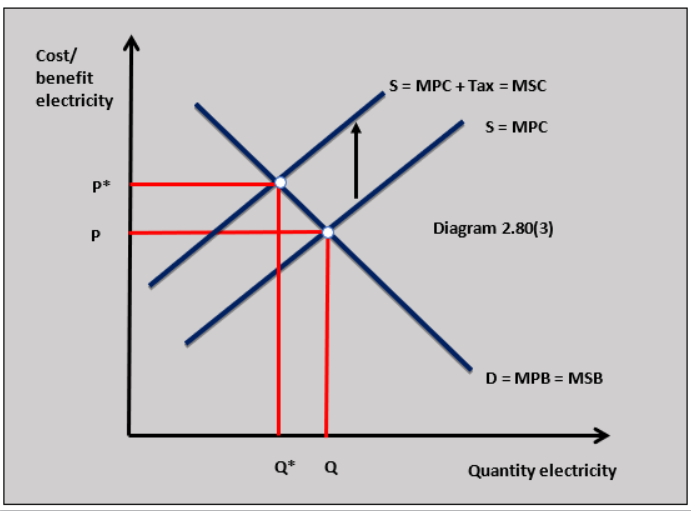
The imposition of a tax is illustrated by diagram 2.80(3) where an energy company with external costs pays a specific tax on the electricity it produces.
The tax reduces the market output Q towards the socially efficient level Q* and decreases (or eliminates) the welfare loss triangle.
Tax on consumption external costs and demerit goods
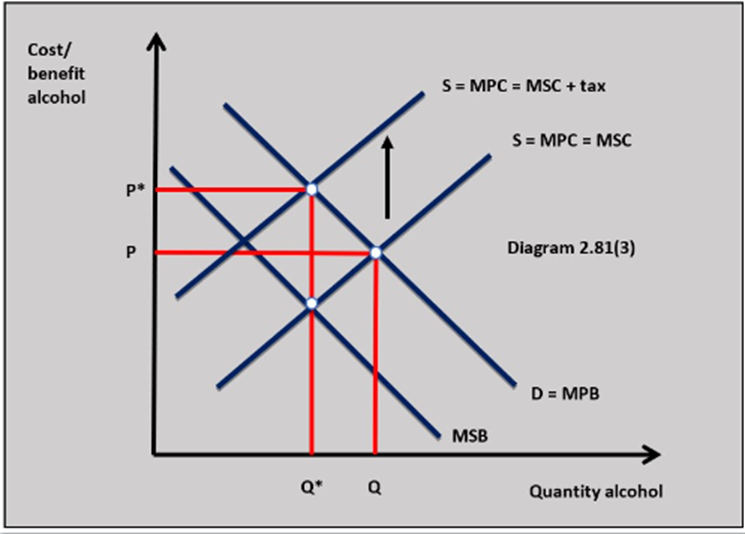 Where the consumption of a good is associated with negative externalities of consumption the government can impose an indirect tax.
Policies used to manage consumption external costs can be used to deal with similar market failures associated with demerit goods.
Governments often tax demerit goods such as cigarettes and alcohol because of the negative externalities associated with their consumption.
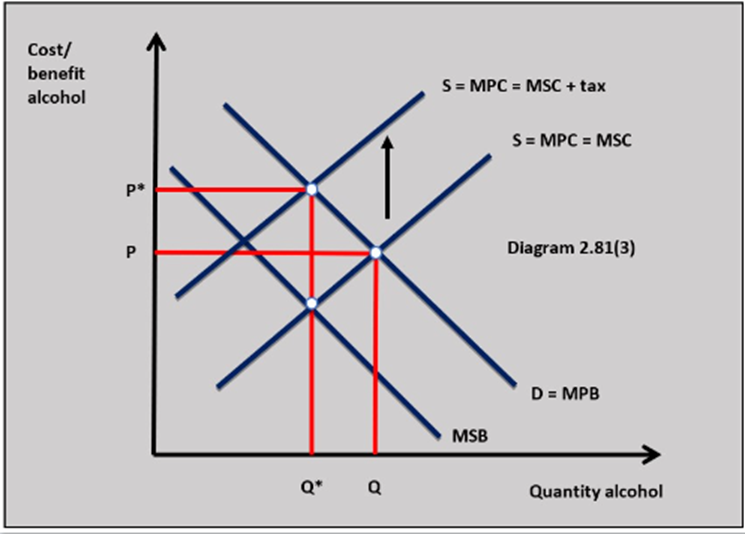
Diagram 2.81(3) illustrates the impact of an indirect tax on alcohol.
This reduces the market output Q towards the socially efficient level Q* and decreases (or eliminates) the welfare loss triangle.
Advantages of using tax:
- Increasing price through tax is an effective way of reducing consumption and production.
- Tax revenue can be used to compensate affected third parties and to pay for the negative consequences of an externality.
- Tax revenue can be used to pay for some of the healthcare costs of people who smoke or drink alcohol.
Disadvantages of using tax:
- Tax can reduce the welfare of low-income groups where the price of a good is a significant proportion of their income.
- Increasing business costs can lead to lower business profits and even business failure.
- Higher costs and prices caused by a tax can add to inflation.
- A tax can make domestic firms uncompetitive in international markets.
- Indirect tax can cause unemployment if industry output falls.
Regulation of production external costs
Governments can regulate production externalities by requiring firms to meet certain laws and regulations when they are producing goods and services.
The construction industry is subject to government regulations when it is planning building projects and needs to meet different planning regulations.
Regulation of consumption external costs
The strictest form of regulation is to make the consumption and production of a good with significant external costs illegal. Some countries make recreational drugs illegal.
Governments can allow the consumption and production of a good but control the market.
Alcohol is a legal recreational drug but its consumption is controlled in many countries in the form of age restrictions, licensing hours, licensed retailers and restricted consumption in public places, etc.
Advantages of regulation:
- They can be targeted more specifically at a negative externality than taxation.
- They are less likely to lead to an increased price than a tax if firms can comply with the regulation relatively easily.
Disadvantages of regulation:
- The cost of implementing legal restrictions can be significant for governments.
- Parallel markets arise in regulated markets and the goods provided can be in the hands of criminal gangs.
- Regulations can drive up business costs increasing prices for consumers.
- Firms can find their way around regulations.
- Businesses often locate production facilities in countries with lower regulations, which adversely affects domestic employment and can move the externality problem to another country.
Definition of tradeable permits
Tradeable permits (cap and trade schemes) involve businesses being issued permits by the government which allow them to emit a certain amount of pollution.
An example of tradeable permits is carbon trading.
How the system works
The system for carbon (C02) trading works in the following way:
- The government sets a total limit on the C02 emissions for an industry.
- The total carbon emissions are then divided up amongst producers.
- The producers are not allowed to emit more CO2 than their allowance.
- The producers have an incentive to reduce their CO2 emissions because they can sell any unused allowance.
- If the government reduces the number of permits their price and value rise and there is a greater incentive for producers to reduce their emissions.
Advantages of tradeable permits:
- Carbon credits create an incentive system that is more effective at reducing CO2 than a tax.
- Using an incentive-based system facilitates innovation and firms develop technology to reduce pollution.
Disadvantages of tradeable permits:
- The system is complicated and expensive to set up and administer.
- The number of permits allowed needs to be tightly controlled at an international level.
- The permits add to business costs and lead to higher prices.
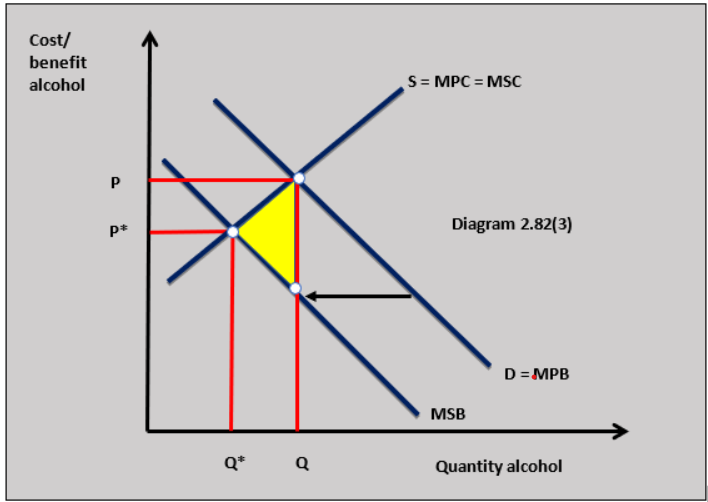 External costs of consumption and production can be managed by reducing the demand for goods associated with negative externalities to the socially optimum level of output.
This can be done through government-financed advertising and educational campaigns.
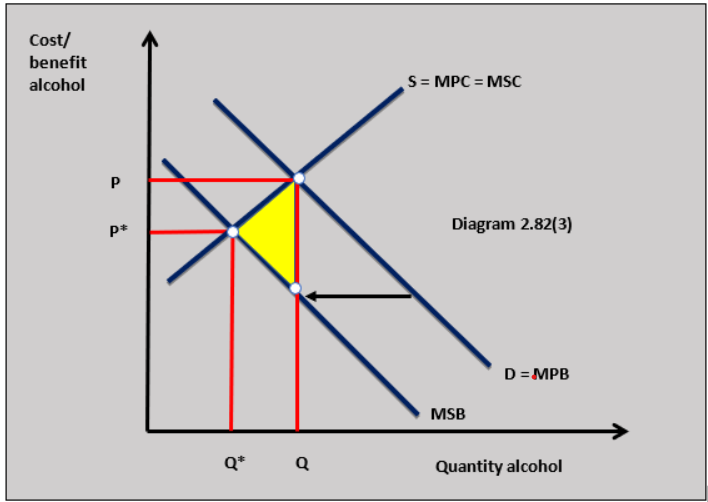
Diagram 2.82(3) illustrates the effect of anti-alcohol advertising.
Many countries run advertising and educational campaigns to persuade people to give up smoking or taking recreational drugs.
Governments can reduce the demand for goods associated with negative externalities by subsidising products that are substitutes for the ones with negative externalities.
For example, subsidising public transport causes the demand for private car use to fall along with the negative externalities associated with the use of cars.
Advantages of reducing demand:
- Advertising does not add to business costs so the price of goods does not increase.
- This can be an effective long-term solution to the problem because it changes consumer behaviour.
Disadvantages of regulation:
- There is an opportunity cost to the government of paying for advertising, education and subsidies.
- The effectiveness of advertising and educational programmes is difficult to measure.
Using a real-world example, evaluate the effectiveness of regulation as a policy to decrease the market failure associated with the consumption of cigarettes. [15]

 Twitter
  Facebook
  LinkedIn