

Question 1: Unit 3.3
(a) Explain why deflation may reduce the level of national income within a country? [10 marks]
How to write this part (a) response:
Introduction
Define the economics terms used in the first part of the essay - deflation
Main Body
Using an appropriate diagram illustrate both cost-push (good) deflation and demand-pull or bad deflation
Using accurate specialised terminology explain the negative impacts of cost-push (good) deflation and demand-pull or bad deflation on consumption, investment and economic growth
Conclusion
Concise summary, consistent with the main body (do not add any new information in the conclusion)
Click on the arrow to view my exemplar response
Command term: Suggest
Deflation can be described as a period when average prices in the economy are falling and should not be confused 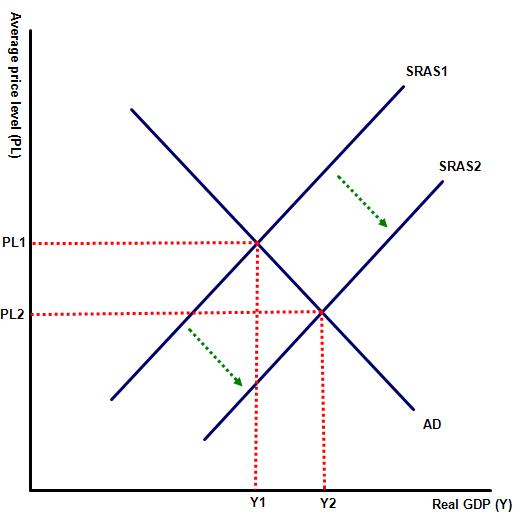 with disinflation, which represents a fall in the rate of inflation. [Key terms].
Deflation is illustrated in the following two diagrams, showing both kinds of deflation, cost-push (good) deflation and the other demand-pull or bad deflation. [Application]. The cost-push deflation diagram (to the right) is illustrated by a rise in the AS curve leading to lower average prices. Diagram two illustrates demand-pull deflation and is illustrated by a fall (or left shift) in the AD curve, leading to a deflationary gap, represented on diagram 2 by a fall in national income from Y1 to Y2. [Analysis and diagrams explained].
Typically, deflation is a sign of a weakening economy. Economists fear deflation because falling prices lead to lower consumer spending, which is a major component of economic growth. Companies respond to falling prices by slowing down their production, which leads to layoffs and salary reductions. 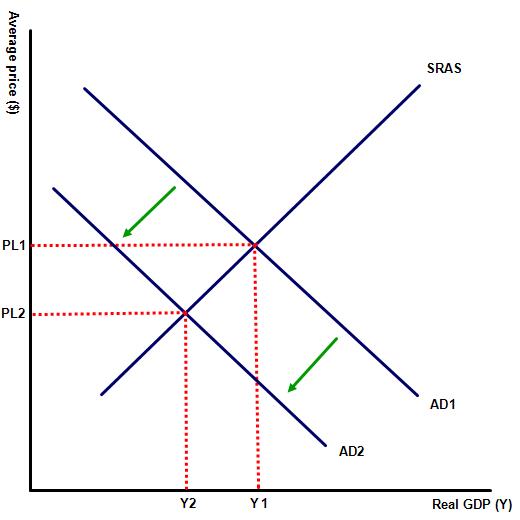 [Analysis].
When an economy experiences a sustained period of deflation there is a fall in consumption levels as many consumers delay certain purchases in the expectation of further price falls - deferred consumption. Debtors, including those with mortgage payments, will see their debts increase in relative terms, as the size of the loan grows in relation to the value of the asset secured on it. This in turn leads to falling real wealth and further reductions in consumption and investment. In this situation, many creditors will not be repaid leading to further job losses and loss of output. [Analysis].
This is sometimes called the reverse multiplier effect, where by falling levels of income, consumption, employment and investment lead to further falls. Once established in the economy governments may be powerless to prevent deflation simply by expanding the monetary supply, because interest rates cannot fall below zero for example. [Analysis].
Key terms used: deflation, cost-push (good) deflation, demand-pull or bad deflation, deflationary gap, reverse multiplier effect
(b) Using real world examples, evaluate whether inflation or deflation is more harmful to an economy. [15 marks]
How to write this part (b) response:
Introduction
Define the economics terms not used in the first part of the essay - inflation and deflation
Main Body
Using accurate specialised terminology and a suitable diagram illustrate inflation and deflation.
Using accurate specialised terminology and an appropriate diagram, show and explain the negative effects of inflation on an economy.
Using accurate specialised terminology and an appropriate diagram, show and explain the negative effects of inflation on an economy.
Demonstrate a balanced approach both in support of and the arguments against the view that perfect competition will operate more efficiently than firms in monopoly.
Use real life examples, ideally from your own country, fixed to the command term.
Conclusion
Concise summary, consistent with the main body (do not add any new information in the conclusion)
Click on the arrow to view my exemplar response
Command term: Evaluate
In this question the command term requires a response that determines the importance or value of the above statement.
Deflation can be described as a period when average prices in the economy are falling while inflation describes a period when average prices in the economy are rising. [Key terms].
Inflation is illustrated in diagram one and shows average prices rising as a 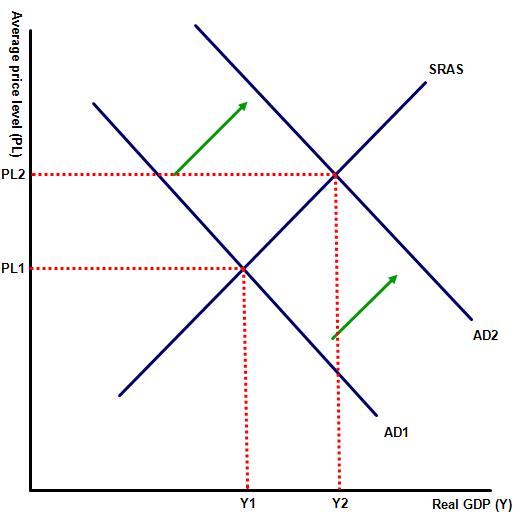 result of higher aggregate demand in the economy. This could have been a result of an increase in one or more of the components of AD and typically exists when income levels are rising and demand for goods and services rises beyond the capacity of the economy to produce those goods and services. Cost-push inflation (sometimes referred to as bad inflation) occurs when production costs rise and might occur as a result of geopolitical events such as wars forcing up the price of food and energy (as in the case of the 2023 Russia/Ukraine war) or disruptions to the supply chain caused by economies closing businesses during the Covid-19 pandemic. [Analysis and real-world examples used].
When either of those two inflationary pressures occur AD>AS and prices will be bided up and more and more consumers chase the products available. [Application].
The impact of inflation, on the wider economy then depends on the type of inflation (cost-push) or as in diagram one demand-pull and whether the rise in average prices has been anticipated or not? [Application]. For example, if people anticipate the rise in average prices then the effect are likely to be less damaging but these still include:
Menu costs which are the administrative costs associated with firms needing to constantly change their prices, consumers will also experience costs, called 'shoe-leather costs', as they are forced to shop more often (before prices rise further), while inflation (even predicted inflation) can cause distortions to the tax system, with both direct and indirect taxes are affected by inflation. When prices are rising quickly the tax paid on items, as well as income is unlikely to keep up with inflation and this has the effect of dragging more people into higher tax brackets, a process called fiscal drag. [Impact of expected inflation on the economy analysed].
The impacts of inflation can be even more serious when the rate of price increase is sudden and or excessive, for example unexpected spikes in prices can make it very difficult for firms to plan ahead, particularly in terms of their investment plans, given the length it takes many projects to make a profit. [First impact of unexpected inflation on the economy analysed].
A second impact is likely to be distortions in incomes with some groups able to earn rises in inflation in line with price rises, while others remain left behind. This also applies to resource costs because in times of unexpected inflation the cost of production inputs do not all rise at the same level. For example, during the recent inflation period of 2023, caused by Covid disruption to supply chains and war in eastern Europe, the cost of food and energy rose much quicker than general price levels. This meant that those businesses heavily dependant on either commodity were disproportionately impacted. Similarly, while rises in consumer inflation reduced living standards across the board, the rise in food and energy prices, that make up a large proportion of lower income budgets, meant that low income families suffered significantly more than those on middle and high incomes. [Second impact of unexpected inflation on the economy analysed].
A third impact of unexpected inflation is that it creates an arbitrary redistribution of income, and is particularly unfair on people who have borrowed money as they will be better off, having less to pay back in real terms. Savers, on the other hand, will be worse off as inflation is eroding the value of their savings. People on fixed incomes or with fixed savings like pensioners may be the worst off. It can be really demoralising to have saved all your life for retirement, only to find that the money you have saved is worth less and less every year because of inflation. [Third impact of unexpected inflation on the economy analysed].
Finally, when a nation experiences a higher rate of inflation than their main competitors they are likely to see a decline in their competitiveness. Markets are becoming increasingly globalised and firms have to compete with other firms all over the world. If a country's inflation rate is faster than other countries, then it makes it much more difficult to compete. This will tend to make exports suffer, but at the same time imports become relatively cheaper. [Third impact of unexpected inflation on the economy analysed].
Examples of nations that have experienced severe economic difficulties, caused by excessive inflation in recent years include Venezuela and Zimbabwe, with Turkey perhaps not too far away. In each case the hyper inflation created has driven living standards through the floor, forcing many living their to seek opportunities overseas. [Real-world examples].
.jpg)
Turning now to deflation, illustrated in the second diagram, showing demand-pull deflation and is illustrated by a fall (or left shift) in the AD curve, leading to a deflationary gap, represented on the diagram by a fall in national income from Y1 to Y2. [Analysis and diagrams explained].
So given the difficulties highlighted in the first part of the essay, might deflation not a good thing? Who would not like a world where things consumers buy get cheaper over time? [Second part of the essay introduced]. However, it is important to realise that in addition to falling prices of goods and services, other prices would be falling too. For instance, falling wages are likely to accompany falling prices (since wages are the price of labour). Should wages fail to adjust (as many economist believe can happen then jobs could be lost as employers struggle to keep up with falling revenues. [Application].
An example of a nation gripped by deflation includes Japan, that endured long periods of deflation and has seen real income levels fall behind many other developed nations. [Real-world example].
Deflation can also cause significant damage to an economy, including the following:
The first is the loss of output, with deflation generally consistent with a weak economy caused by a collapse of aggregate demand - a drop in spending so severe that producers must cut prices on an ongoing basis in order to find buyers. [First impact of deflation on the economy analysed].
Secondly, a further effect of deflation can be reduced employment resulting from wage rigidity. It is reasonable for producers who face lower prices of their goods to cut wages too, to counteract the reduction in revenues with a reduction in costs. However, when prices fall, wages might not adjust instantaneously. If employers are in fact unable to lower wages, they might counteract the reduction in revenue instead by restricting employment. This, in turn, will lead to further output and income loss, because labour is a major input into production. [Second impact of deflation on the economy analysed].
Arbitrary redistribution of wealth from borrowers to lenders can be a third impact of deflation. Used to periods of sustained inflation (even small rates of inflation) many long-term contracts are written with the expectation of continuing inflation. Thus, when unanticipated deflation occurs, these contracts need to be adjusted. It is reasonable to expect that these adjustments will not be instantaneous, since many contracts cover an extended period of time. Without adjustments, unexpected deflation will lead to arbitrary redistribution of wealth from borrowers to lenders (the opposite of the case of unanticipated inflation). [Third impact of deflation on the economy analysed].
Finally there is the costs to monetary policy. The tool of many central banks (including the Fed) is short-term interest rates (the fed funds rate in the case of U.S. Recall that periods of deflation are also periods of weak economy. The “remedy” for the weak economy would be lower nominal interest rates. When we think about the link between interest rates and output, we want to think about the real interest rate, the difference between the nominal interest rate and inflation. When inflation is positive, it is possible for the central bank to push real interest rates down (even below zero) and stimulate investment spending and, perhaps, spending on durable goods. That, in turn, should boost overall output. However, nominal interest rates cannot fall below zero. Therefore, as the Japanese experience showed, in a situation with deflation and a recession, the central bank may not be able to push real interest rates low enough to alleviate the situation. [Final impact of deflation on the economy analysed].
Given the above might it can reasonably be deduced that the optimum level of average price rise is probably a small, steady (and predictable) rate of inflation, resulting from growth in aggregate demand. [Evaluation]. That said, a very small level of supply side deflation, caused by falling production costs (shown on diagram 3), cost push deflation, might also be considered good deflation, where as falling prices as a result of falling aggregate demand levels, demand pull deflation, is considered bad deflation and may have a relatively positive impact on the economy. [Conclusion].
Key terms used: average prices, cost-push inflation/deflation, demand-pull inflation/deflation, aggregate demand/supply, menu costs, shoe leather costs, nominal and real interest rates, taxes, interest rates
Feedback
Which of the following best describes your feedback?
 Twitter
  Facebook
  LinkedIn