


This page covers merit and demerit goods. It explains the theory behind these goods and why they are a market failure.
Nature merit goods
Definition of merit goods
Merit goods are goods that society says people should consume because they are associated with significant social benefits.
Examples
Examples include goods such as health, education, healthy food, recreation facilities, housing, museums and theatres.
Merit goods as market failure
Merit goods are an example of market failure because they tend to be under-consumed in free markets and this leads to an under-allocation of resources.
Merit goods are often associated with significant external benefits to society from their consumption, and these are not accounted for in the free market allocation of resources.
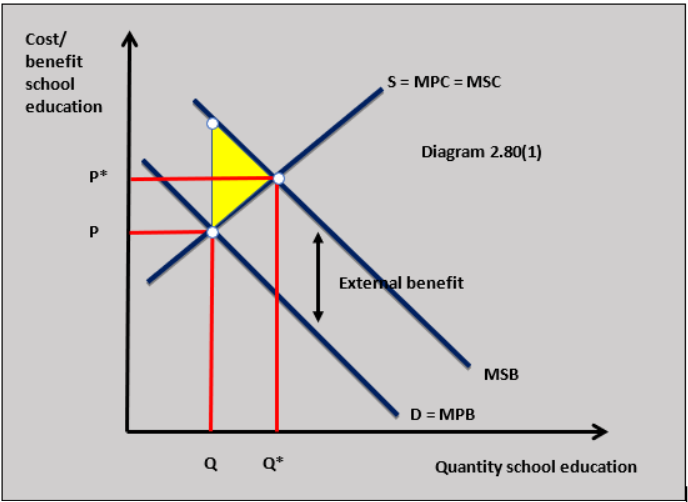
External benefits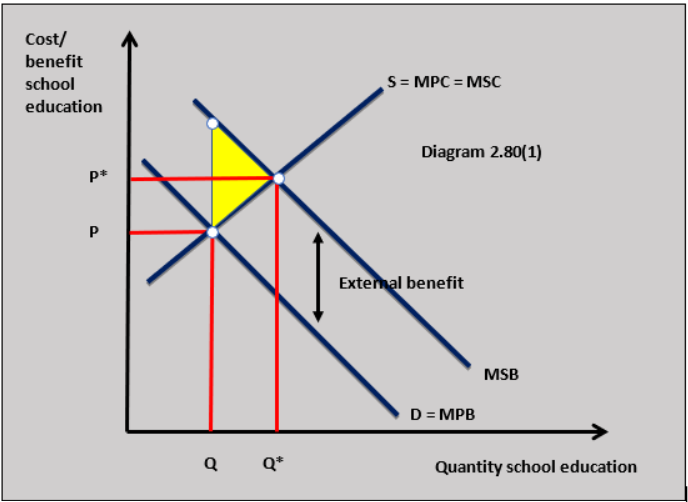

When people are deciding to buy a good or service they do not consider the external benefits of consuming the good.
For example, there are significant positive externalities associated with children attending school as they provide a more skilled workforce.
Diagram 2.80(1) illustrates the underconsumption of school education and its associated welfare loss.
Undervalued private benefits
Individuals make buying decisions based on their assessment of the private benefits the consumption of a good will give to them.
People often undervalue the benefits the consumption of a merit good will bring to them and this means the merit good will be under-consumed.
Low incomes households
Low-income income may not be able to afford merit goods in a free market.
For example, the children of low-income households will miss out on the significant private benefits of attending school and society will not benefit from the positive externalities of educating the children of low-income households.
Nature of demerit goods
Definition of demerit goods
Demerit goods are goods that society says people should not consume because their consumption is associated with significant social costs.
Examples
Examples of demerit goods include alcohol, cigarettes, firearms, violent video games and recreational drugs.
Demerit goods as a market failure
Demerit goods are an example of market failure because they tend to be over-consumed in free markets.
Without any state intervention in a free market, there will be an over-allocation of resources. One of the key reasons for this is that demerit goods are associated with negative externalities.
External costs
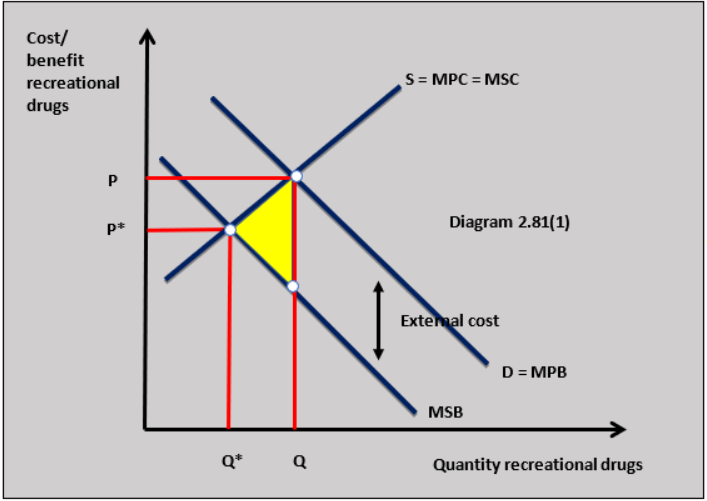
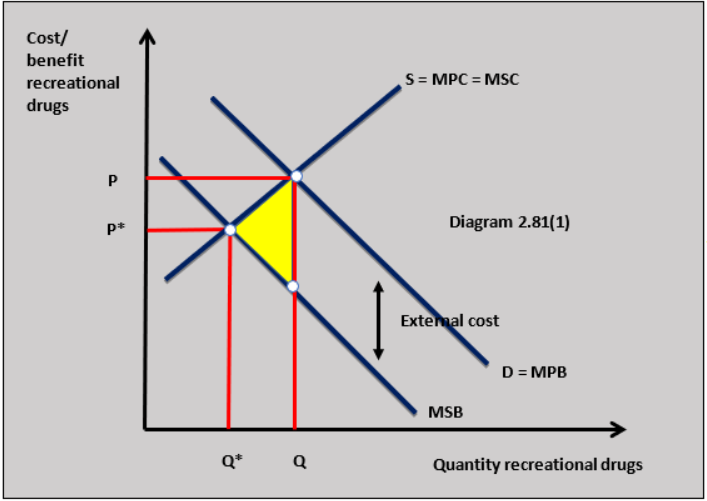 The consumption of demerit goods is often associated with external costs which individuals do not consider when they consume the demerit goods.
For example, recreational drugs lead to negative externalities such as anti-social behaviour and low productivity at work.
Diagram 2.81(1) shows how the over-consumption of recreational drugs and the associated welfare loss.
Overvalued private benefits
People often overvalue the benefits the consumption of a demerit good will bring to them and this means the demerit good will be over-consumed.
Explain why demerit goods might lead to market failure. [10]
 Twitter
  Facebook
  LinkedIn