


This page covers market failure, negative externalities of consumption and production along positive externalities of consumption and production.
Definition of market failure
Markets fail when the free market forces of demand and supply lead to an allocation of resources that does not maximise the welfare of a country’s citizens.
It means that the marginal social costs do not equal the marginal social benefits.
Economists often express market failure as a misallocation of resources or where resources have been allocated inefficiently.
Externalities
Externalities are any impact that the production or consumption of a good or service has on a third party.
A third party is someone other than the producers and consumers of a good or service in a market.
Negative externalities or external costs
External costs are the spillover costs that negatively impact third parties resulting from producing or consuming a good or service.
Economists divide external costs/negative externalities into:
- Production external costs
- Consumption external costs
Positive externalities or external benefits
External benefits are the spillover benefits that positively impact third parties as a result of the consumption or production of a good or service.
Economists divide external benefits/positive externalities into:
- Production external benefits
- Consumption external benefits.
Definition of productional external costs
Production external costs are the spill-over costs on third parties that come from the production of a good or service.
An example would be waste from a cement factory that pollutes a river, adversely affecting the people who live near the river.
Marginal private costs (MPC)
These are the raw materials, labour and capital used in producing a good or service. Each extra unit produced by the firm is a marginal private cost.
The external costs (negative effects) are not included in the private costs of production.
Marginal social costs (MSC)
The marginal social cost of producing a good associated with an external cost is: MPC + external cost = MSC
Production external costs and market failure
The market output is determined by MPB (demand) and MPC (supply).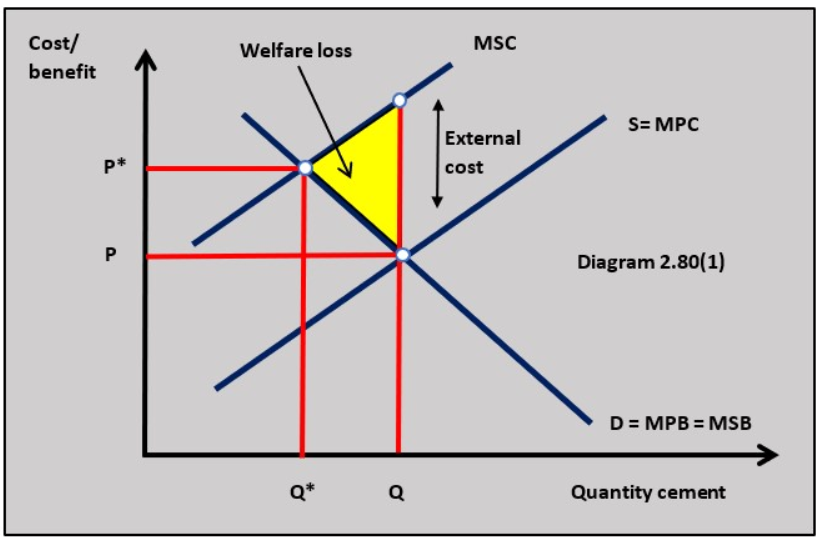
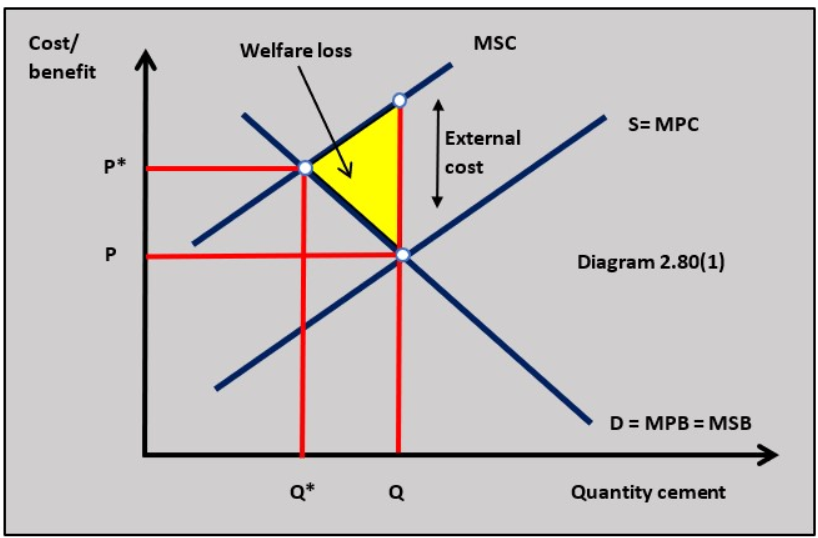
In the cement market example, this is set where the MPB = MPC at output Q and price P in diagram 2.80(1).
The socially efficient output is set where MSB = MSC at Q*, below the market output at Q. This is shown in diagram 2.80(1).
Welfare loss
A welfare loss to society occurs in a market when the output of a good or service means the MSC is greater than MSB.
The yellow shaded area in diagram 2.80(1) shows the total welfare loss in the cement market example.
At each level of output beyond Q* in diagram 2.80(1) MSC is greater than MSB, which means that the cost to society of each extra unit of cement produced is greater than the benefit.
Definition of productional external costs
Consumption external costs exist when third parties experience the external cost from the consumption of a good or service.
An example would be when people drink alcohol and their behaviour adversely affects other people. The high rate of illness caused by drinking alcohol means drinkers take up more resources in the health service than non-drinkers.
Marginal private benefits (MPB)
Private benefits are the utility an individual receives from consuming a good or service. MPB is the utility an individual receives from consuming an extra unit of a good.
Marginal social benefits (MSB)
The marginal social benefit of consuming a good with negative externalities is: MPB + external cost = MSB
Consumption external costs and market failure
The 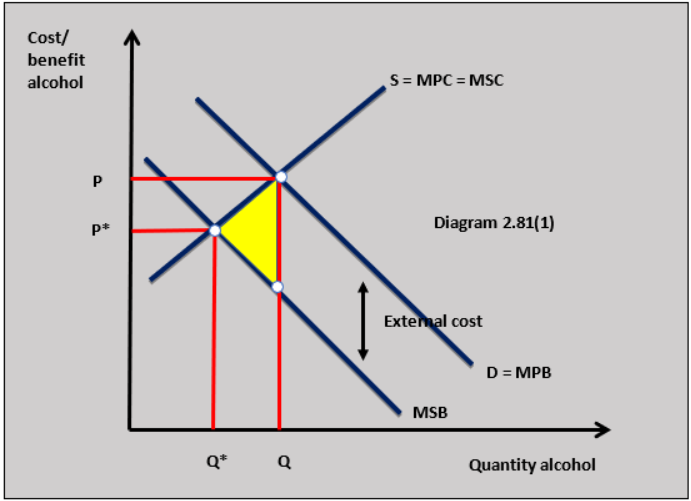 market output is determined by MPB (demand) and MPC (supply).
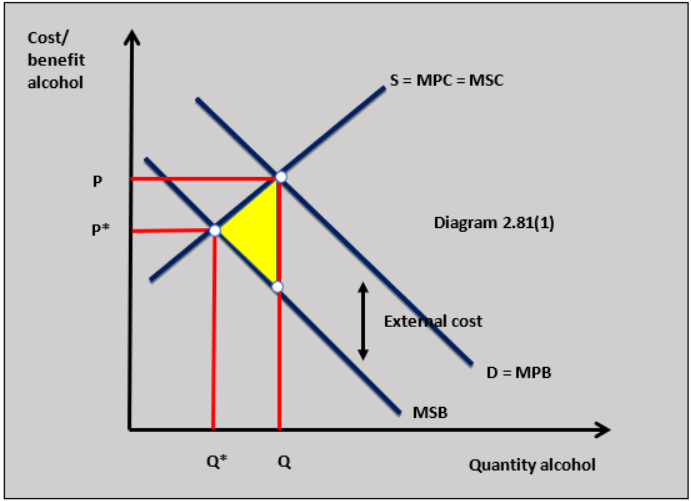
In the alcohol market example, this is set where the MPB = MPC at output Q and price P in diagram 2.81(1).
The socially efficient output is set where MSB = MSC at Q*, below the market output at Q. This is shown in diagram 2.81(1).
The alcohol market is producing at output Q which is above the socially efficient level at Q*. This is a market failure because there is an over-allocation of resources in the cigarette market.
Welfare loss
The yellow shaded area in diagram 2.81(1), represents the welfare loss to society from the over-allocation of resources in the alcohol market.
At each level of output beyond Q* MSC is greater than MSB in diagram 2.81(1).
Definition of production external benefits
Production external benefits are the spill-over benefits that occur as a result of the production of a good or service. For example, an electronics factory opens in a town and benefits the local community.
Marginal private costs
If a new electronics factory opens in a town it may employ local workers in the factory, use local businesses that provide services, and purchase raw materials and components from local producers.
Marginal social costs
The marginal social benefit of producing a good with positive externalities is: MPC + external benefit = MSC
Production external benefits and market failure
The market output is determined by MPB (demand) and MPC (supply). 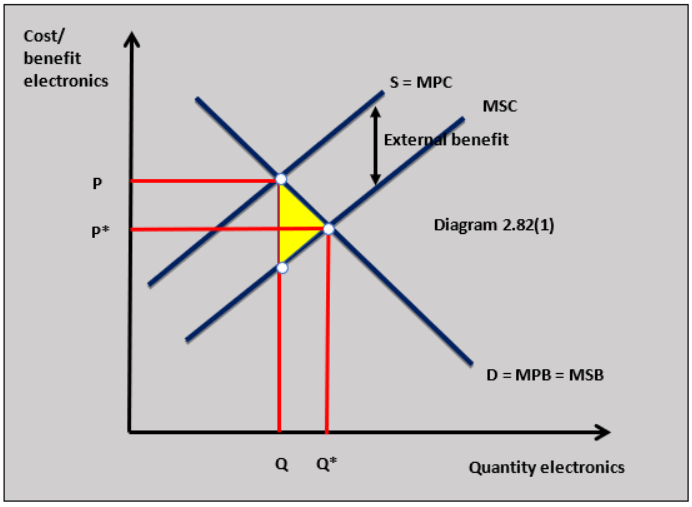
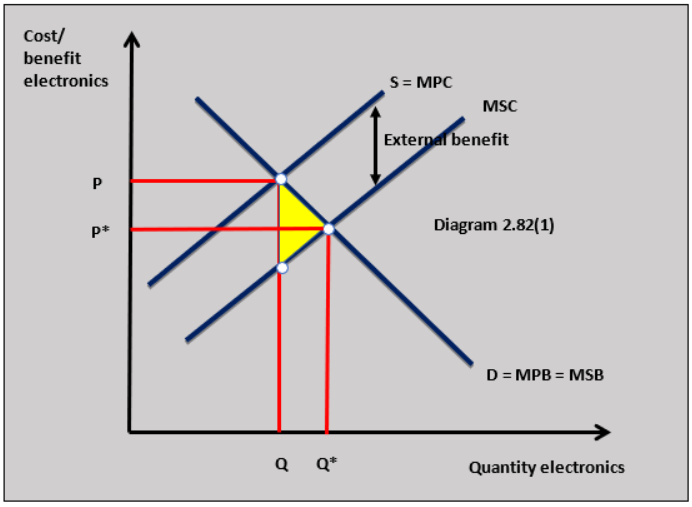
In the electronics market example, this is set where the MPB = MPC at output Q and price P in diagram 2.82(1).
The socially efficient output is set where MSB = MSC at Q*, below the market output at Q. This is shown in diagram 2.81(1).
The electronics market is producing at output Q which is below the socially efficient level at Q*. This is a market failure because there is an under-allocation of resources in the electronics market.
Welfare loss
The blue shaded area in diagram 2.82(2) is the welfare loss to society because of the under-allocation of resources.
The marginal social benefit from the electronics factory is greater than the marginal social cost at each level of output from Q to Q*.
Definition of consumption external benefits
Consumption external benefits occur when a good or service is consumed and there are spill-over benefits on third parties.
An example would be the external benefits in the market for healthcare goods and services when there are benefits to people beyond those who consume healthcare goods and services.
Marginal private benefits
When people purchase a flu vaccination they benefit because they are less likely to catch the flu. This is a private benefit to these consumers, and each extra unit of the vaccination consumed is a marginal private benefit.
Marginal social benefit
The marginal social benefit of producing a good with positive externalities is: MPB + external benefit = MSB
Consumption external benefits and market failure
The market output is determined 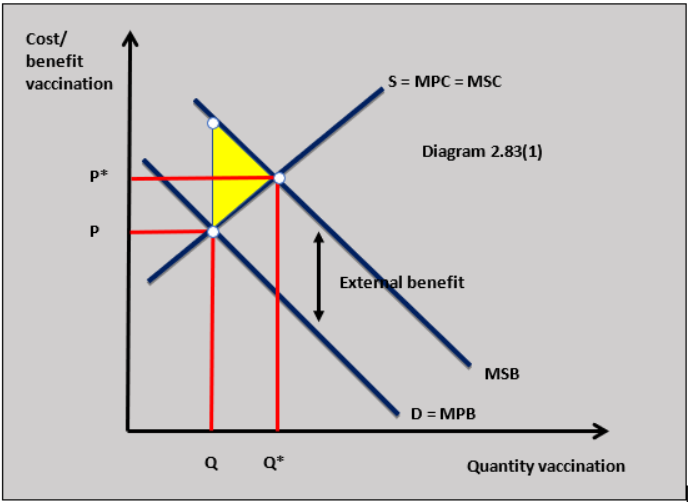 by MPB (demand) and MPC (supply).
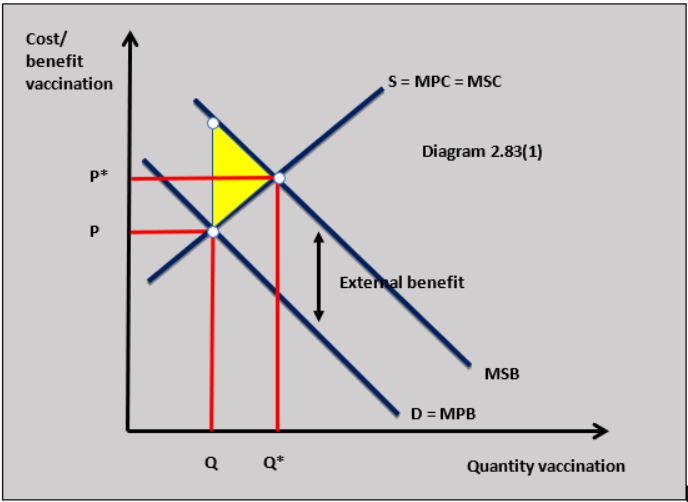
In the vaccination market example, this is set where the MPB = MPC at output Q and price P in diagram 2.83(1).
The socially efficient output is set where MSB = MSC at Q*, below the market output at Q. This is shown in diagram 2.83(1).
The vaccination market is producing at output Q which is below the socially efficient level at Q*. This is a market failure because there is an under-allocation of resources in the vaccination market.
Welfare loss
The yellow-shaded triangle in diagram 2.83(1) represents the welfare loss to society from the flu vaccination.
The MSB from the consumption of the vaccine is greater than the MSC at each level of output from Q to Q*.
Sample paper 1 (10 mark) exam question
Explain why external costs of consumption can lead to market failure. [10]

 Twitter
  Facebook
  LinkedIn