

This page covers the nature of maximum prices and the reasons why governments use them. It also covers the impact of maximum prices on different stakeholders.
Nature of maximum prices (price ceilings)
Definition
A maximum price or price ceiling is a price set by a government or controlling authority to prevent the price of a good or service from rising above a fixed level.
Reasons for maximum prices
Maximum prices are put in place to protect low-income consumers from prices rising in a market to a level they cannot afford.
Maximum prices are normally put on goods that governments feel all people in society ought to be able to consume such as housing, basic food, healthcare and education.
Effects of a maximum price
Rent controls in New York City are an example of the application of a maximum price used to make housing affordable to low-income families.
In New York, the number of houses and apartments subject to rent controls is around 30,000 at present with an average rent of about $1,300 per month. The average market rent would be around $2,500 per month.
Diagram 2.70(3) illustrates the impact of a maximum price on rents in the New York housing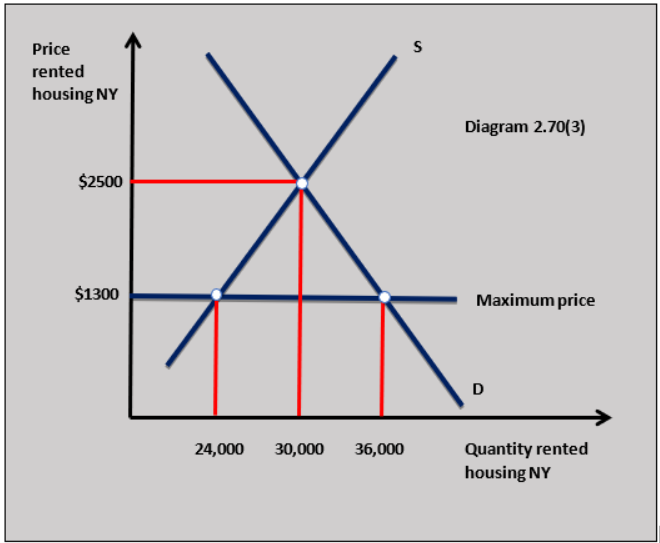 market.
- If the price falls in the market from $2500 to $1300, the quantity demanded increases from 30,000 units to 36,000
- The decrease in price reduces the quantity supplied to 24,000 when landlords withdraw from the market because they make less profit and fewer landlords can cover their costs.
- Excess demand (shortages) for rented housing develops because the quantity demanded is greater than the quantity supplied of rented housing at the maximum price.
- The rationing function of price no longer works effectively. The price cannot rise to clear the market because of the price ceiling.
- Other methods of rationing develop such as queueing (first come, first serve), preferential consumer selection (landlords rent to tenants they favour), regulations develop (landlords are forced to prioritise families) and lottery schemes develop (random selection of tenants).
- Parallel markets develop where consumers and producers try to find their way around the ceiling price controls.
- The quality of rented housing declines because landlords do not have funds to make repairs and maintain their properties as well as they could at the equilibrium price.
- In the long-term new investment in rented housing falls because the market is not as profitable as it would be without the maximum price.
Consumers
The consumers who buy the good or service at a maximum price benefit because they pay a lower price than the equilibrium price.
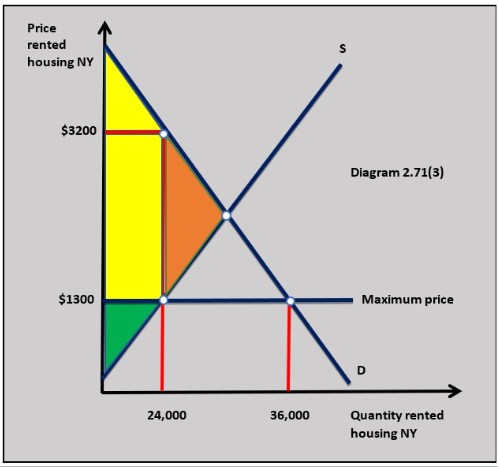
The gain in consumer surplus these consumers receive is shown by the yellow shaded area in diagram 2.71(3).
The consumers who would have paid the market price and cannot buy the good at the maximum price lose their consumer surplus.
Consumers may also lose out because of the time they might spend queueing for a good that is in short supply, or they might encounter extra regulations resulting from the price ceiling.
Some consumers might enter the parallel market where they might have to pay a very inflated price and risk breaking the law.
Producers
Producers lose producer surplus when there is a maximum price which means they receive less revenue and profit from selling their good or service.
Some producers will leave the market when there is a maximum price and their producer surplus disappears.
For the landlords in the rented housing market in diagram 2.71(3), the producer surplus is the green shaded area which is smaller than the producer surplus at the normal market equilibrium price.
Some fringe producers enter the parallel market and make high profits from selling their goods illegally.
Governments
Governments have the cost of setting up and enforcing the maximum price, as well as the loss of tax revenue that might come from lower sales in the market.
There can be political benefits from setting a price ceiling because it looks like an effective policy that reduces prices.
Welfare
Maximum prices lead to a loss of welfare because of the loss of consumer surplus of consumers who no longer buy the good when the maximum price is imposed. This is shown by the shaded area in diagram 2.71(3).
There is also a welfare loss of the producer surplus from producers who leave the market as a result of the maximum price. This is shown by the shaded area in diagram 2.71(3).
Evaluate the effectiveness of a maximum price (price ceiling) as a way of making a good more affordable to low-income households. [15]

 Twitter
  Facebook
  LinkedIn