Define the economics terms not used in the first part of the essay - subsidy and indirect taxes.
Explain that governments intervene in different markets for different reasons, including restricting access to demerit goods, encouraging the use of merit goods, making products/services available to low income families and guaranteeing supplies of essential goods and services.
Using accurate specialised terminology and appropriate diagrams discuss how governments make use of price elasticity when intervening in different markets.
Demonstrate a balanced approach with an awareness of how governments intervene differently in markets with different elasticities.
Concise summary, consistent with the main body (do not add any new information in the conclusion)
Command term: Discuss
Discuss means to offer a considered and balanced review of the various arguments, factors or hypotheses.
Governments intervene in different markets for different reasons and can take the form of taxes, subsidies, minimum price levels, direct provision of goods and services and price ceilings. Any decision to either tax a product or provide a subsidy must consider the price elasticity 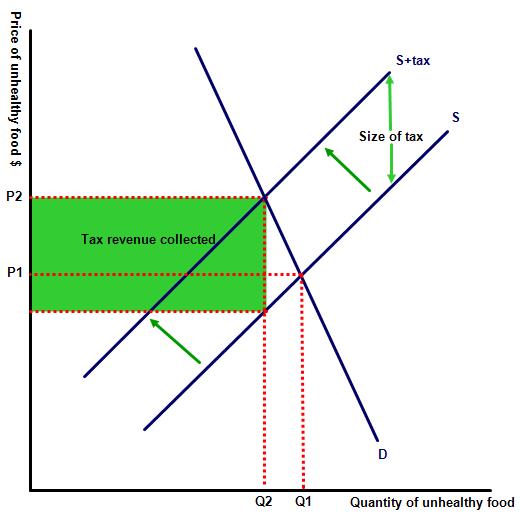 of demand for the market they intervene in?
Considering indirect taxes, these are placed on a good or service to raise government revenue but also discourage consumption of demerit goods e.g. tobacco and alcohol products. [Relevance of PED theory when a tax is applied]. This is illustrated in diagram one, showing the imposition of a tax on unhealthy food. A number of countries have imposed such a tax, sometimes called a 'sugar' or 'fat' tax on unhealthy food and while governments no doubt have designs on how the money raised might be used to encourage healthier eating habits, the principle motivation of the tax, surely, is to reduce consumption levels? [Application]. Unfortunately, for governments motivated by the desire to reduce consumption of demerit goods, the impact of the tax on consumption is relatively small (just Q1-Q2) due to those product's relatively low PED inelasticity. [Analysis]. The low PED is derived from their addictive/habit forming nature and so governments may find that the most significant consequence of the tax is not a significant fall in consumption levels, as intended, but a significant rise in tax revenues. Governments may justify this by using some or all of 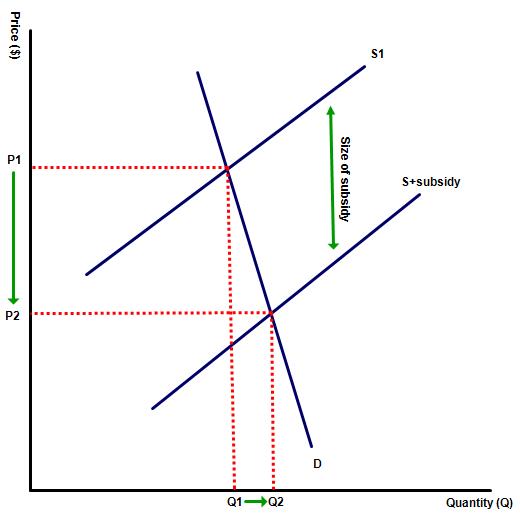 the revenues gained to subsidise merit goods, for instance by taxing unhealthy foods. A government could also use the tax revenue generated to finance a subsidy on fresh vegetables/fruit and/or fund healthy food campaigns. [Analysis].
Similarly when placing a subsidy on a product, with the aim of raising consumption levels, the level of PED elasticity should also be a consideration for the government. [Relevance of PED theory when a tax is applied].
Diagram 2 illustrates the impact of the subsidy on a PED inelastic good. Many governments subsidise a range of PED inelastic products, considered essential for a population's well-being such as public transport, energy or agricultural produce, while many governments in the middle east subsidise bread. In the diagram the subsidy has raised consumption levels, as the governments intended to do, but only by a relatively small amount from Q1 to Q2. By contrast the price of the product falls more than proportionately from P1 to P2, meaning that almost all of the subsidy is enjoyed by existing consumers in the fom of lower prices and only a tiny fraction going towards attracting new consumers to the product. [Diagram explained, showing the relevance of PED theory when a subsidy is applied to a PED inelastic good].
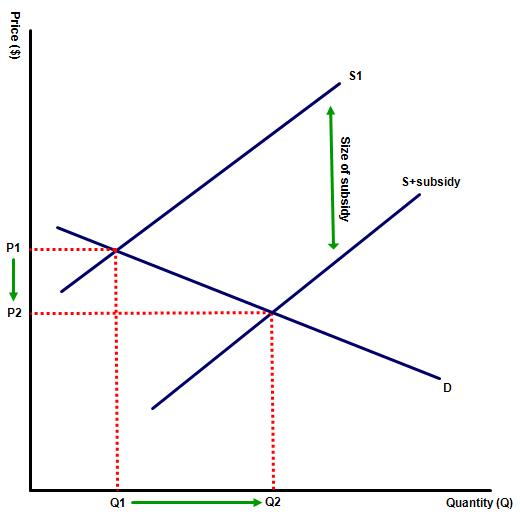 Diagram 3, by contrast, highlights the impact of a government subsidy on a PED elastic good. Once again the subsidy is provided and the benefit of the subsidy is enjoyed by producers (in the form of higher profit margins), existing consumers (in the fom of lower prices) and new customers who now purchase the product given that it is now available relatively cheaply. The difference between the two diagrams, however, is in the proportion of the subsidy that each of the above enjoys. Compared to the subsidy placed on PED inelastic products, when a subsidy is applied to a more elastic good then the subsidy leads to a significant rise in overall consumption, shown on the diagram by a rise from Q1 to Q2, while existing consumers benefit by a relatively small amount in the form of lower prices. [Diagram explained, showing the relevance of PED theory when a subsidy is applied to a PED elastic good].
Given the above, therefore, governments must consider price elasticity theory when making any decision about which goods and services to intervene in? When it comes to taxing a demerit good, in the hope of reducing consumption levels then a government must consider how effective the policy might be? If the good has a low level of elasticity then the policy may be ineffective at reducing consumption, but will raise significant levels of tax revenue for the government, raising the question what exactly is the government's primary motivation for the policy? [Analysis]. Equally, when applying a subsidy to any good or service the government must also consider both the aim of the policy as well as the PED elasticity of the product they intend to intervene in? However, if their priority is to increase consumption levels, as in the case of merit goods, then the subsidy should be targetted at products with a high level of PED elasticity. [Analysis and conclusion]. Finally, if the primary motivation is to reduce the price of the good, making it more affordable for low income families then a subsidy of this nature can be targetted at goods with low levels of PED elasticity. [Analysis and conclusion].
Key terms: Indirect taxes, subsidy, price elastic, price inelastic


 a. Explain why governments impose indirect taxes on specific goods and services. [10 marks]
 Twitter
  Facebook
  LinkedIn