


This page on indirect taxation covers the reasons for indirect tax, a graphical analysis of indirect tax, the effect of PED and PES on indirect tax and the impact of indirect tax on different stakeholders.
Definition
An Indirect or expenditure tax is the tax added to the price of a good or service and collected by the firm selling the good or service and then paid to the government.
Types of indirect tax
There are two main types of indirect taxation:
- Ad valorem tax is a fixed percentage tax added to the price of a good such as value-added tax (VAT).
- Specific tax or duty is a set money value of tax added to the price of a good. Specific taxes are placed (levied) on goods like petrol, alcohol and cigarettes.
Reasons for the use of indirect tax
Indirect taxation is an important source of government revenue.
Governments also use specific taxes to reduce the consumption of goods that they think have significant social costs and negatively affect welfare.
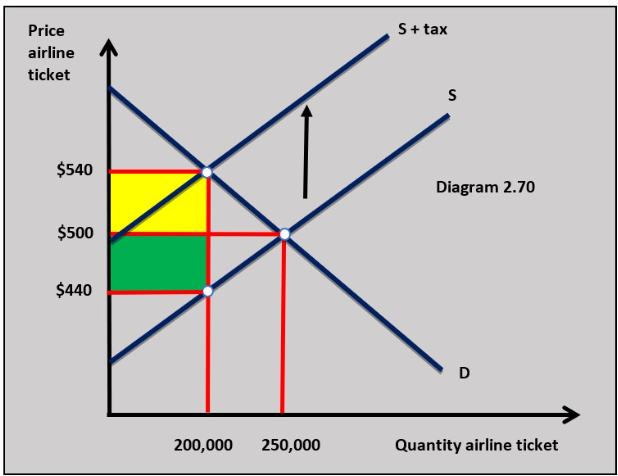
Indirect tax affects supply in a market because it increases the costs of production. For example, an airline’s cost of supplying a flight is $500 and a $100 specific tax is imposed.
The supply cost of that ticket will now be $600 ($500 + $100). This means the supply curve for airline tickets shifts vertically upwards by the specific tax of $100. Diagram 2.70 illustrates the impact of an indirect tax on the market for airline tickets.
 The effects of a specific tax of $100 levied by the government on the airline market would be:
 - The tax leads to a fall in market supply as the airlines add $100 to the cost of supplying airline tickets. This gives a new equilibrium price of $540 with 200,000 tickets sold.
- The total tax collected by the government is calculated by multiplying the quantity sold multiplied by the indirect tax per unit. In this case $100 x 200,000 = $20,000,000 which is partly paid by the consumer and partly by the producer.
- The consumer pays $40 x 200,000 = $8,000,000. This is known as the consumer incidence (yellow area) of the tax and it leads to a reduction in the consumer surplus.
- The producer pays $60 x 200,000 = $12,000,000. This is known as the producer incidence (green area) of the tax and this means a reduction in the producer surplus.
Price elasticity of demand and supply will affect the size of tax revenue received by the government as well as the incidences of tax paid by the consumer and the producer.
Price elasticity of demand
Governments often favour taxing goods with price inelastic demand because the revenue collected is high and the tax incidence falls more on the consumer than the producer.
A higher incidence on the producer is more likely to result in a cut in output which could cause unemployment.
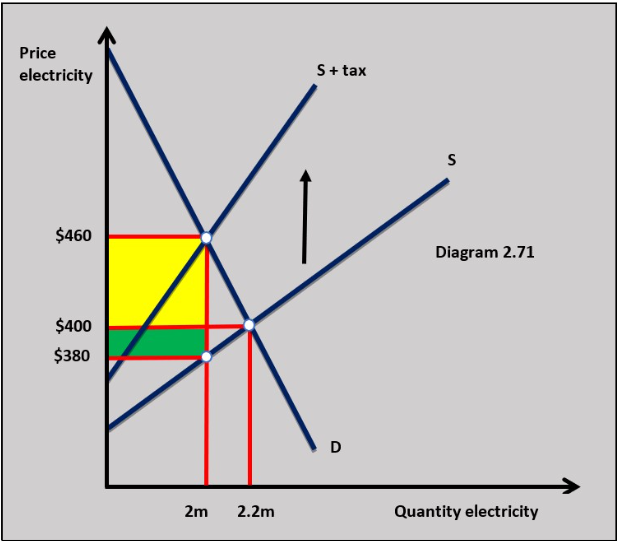 In diagram 2.71 an ad valorem tax of 20 per cent is put on the price of household electricity.
The ad valorem indirect tax put on a good the supply curves diverge as the price increases.
When 20% is added to the price of a good that is $100 the indirect tax is $20 and if the good costs $500 the tax is $100.
Because the PED of electricity is price inelastic the incidence of tax falls more heavily on the consumer (yellow area) relative to the producer (green area) and the tax revenue for the government is greater.
Price elasticity of supply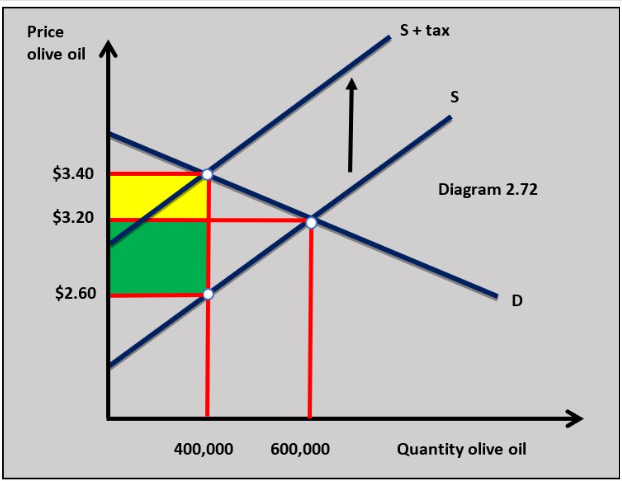
PES also affects the tax collected by the government and the size of the incidence on the consumer and the producer.
When the PES of a good is greater than the PED the consumer incidence is greater than the producer incidence
When the PES is less than PED the producer incidence is greater than the consumer incidence.
Diagram 2.72 show a tax of 0.80c on olive oil where PES is less than PED and the consumer has an incidence shown by the yellow area and the producer the green shaded area.
Consumers
Individuals who buy goods that have been taxed pay a higher price and experience a loss of consumer surplus.
It can be argued that when people are buying goods associated with social costs like alcohol, the higher price reduces their consumption and this increases their welfare in the long term.
Producers
Businesses in markets that are taxed must pay their incidence of tax and this reduces their producer surplus.
This may lead to a fall in business profits which reduces long-term investment and this could lead to workers being made redundant.
Government
Governments benefit from the revenue they receive from indirect taxes which they can use to spend on public services.
There may also be benefits from a reduction of goods associated with social costs such as alcohol.
There may be some negative political consequences from an industry badly affected by a tax.
Welfare
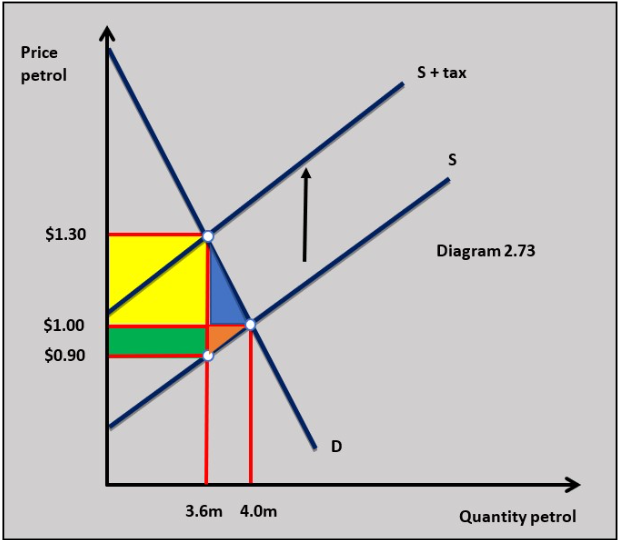
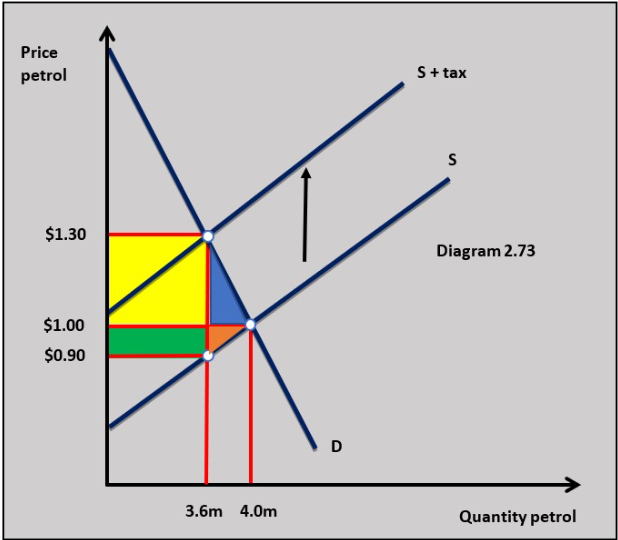
When a tax is applied to a good it will change the allocation of resources in the market. Diagram 2.73 shows the welfare loss associated with a $0.40 tax on petrol. This is made up of two elements:
 Consumer welfare loss
When the price increases from $1 to $1.30 consumer surplus of the people who would have bought the petrol at $1 but will not buy it at $1.30 disappears.
This is called the consumer welfare loss and is shown in diagram 2.73 by the blue shaded area.
Producer welfare loss
The producer incidence of the tax in diagram 2.73 is $0.10c. When this is applied to the petrol market some producers will fail (go bankrupt) or will choose to leave the market.
This is called the producer surplus will be lost to the economy and this is shown in diagram 2.73 by the brown shaded area.

 Twitter
  Facebook
  LinkedIn