


This page focuses on price elasticity of demand (PED). It covers its definition and measurement, the interpretation of the PED value, the determinants of PED, the effect of PED on revenue, types of goods and PED, and an evaluation of PED.
Definition of PED
Price elasticity of demand is the responsiveness of quantity demanded for a good to a change in its price.
It is measured by the equation: % change in Qd / % change in P
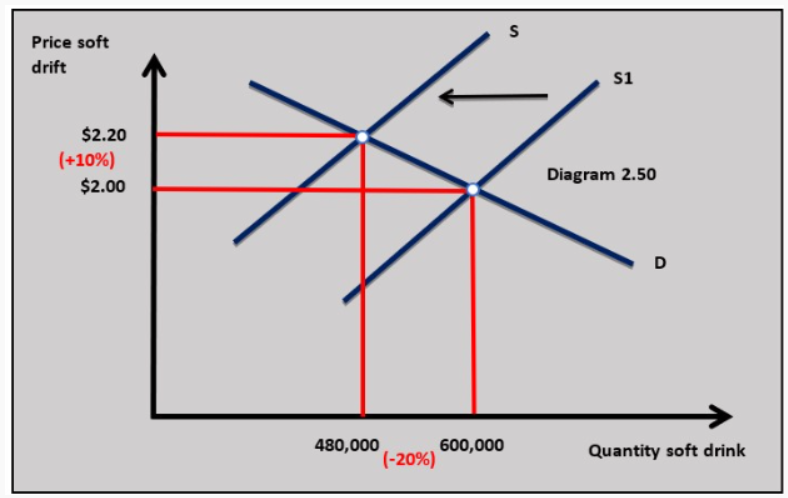
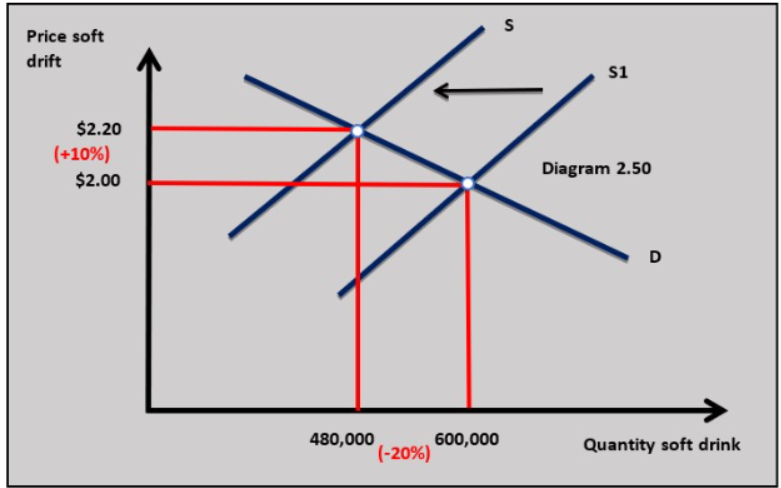 For example, if the price of a soft drink rises from $2.00 to $2.20 and the quantity demanded falls from 600,000 units to 480,000 the PED would be:
-20% QD / +10% P = -2 or +2 (PED). This is shown in diagram 2.50.
The value of PED is normally negative because of the law of demand. The negative value is often ignored because the PED value is nearly always negative.
Price elastic demand
If the PED value is greater than 1 then the good’s demand is price elastic. This means a change in price leads to a proportionately greater change in quantity demanded.
Theoretically, the demand curve can be perfectly horizontal or perfectly elastic. This gives a PED of infinity.
Unitary elasticity of demand
If the PED value is 1 then PED is unitary. This means that for every 1% change in price, the quantity demanded changes by 1%.
Price inelastic demand
If the demand for a good has a PED value of less than 1 then it is price inelastic. This means that a change in the price of a good leads to a less than proportionate change in quantity demanded.
Demand curves with differing elasticities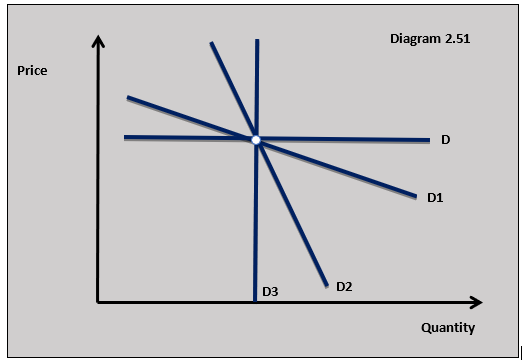
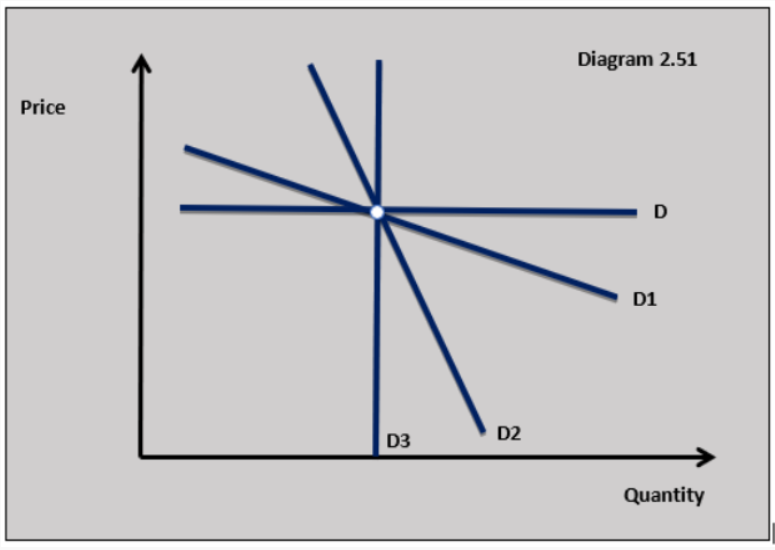
Diagram 2.51 shows demand curves of different slopes to represent different PEDs.
- Horizontal demand curve is perfectly elastic (D)
- Relatively flat gradient is price elastic (D1)
- Relatively steep gradient is price inelastic (D2)
- Vertical demand curve is perfectly inelastic (D3)
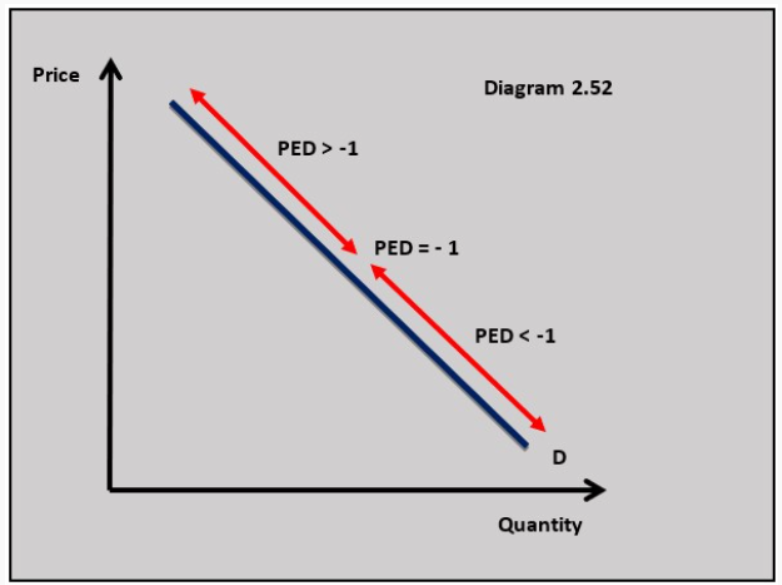
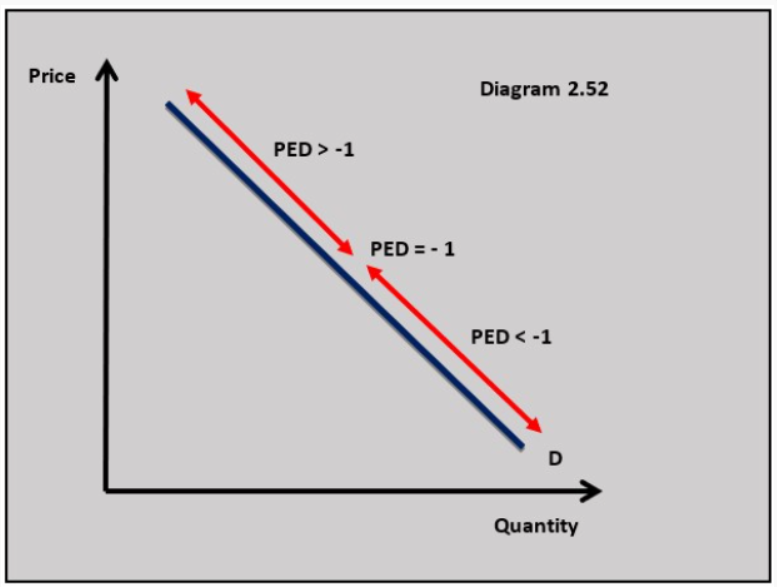 All demand curves (except the perfect ones) have a PED that changes from elastic to inelastic as the price of the good decreases; this is shown in diagram 2.52.
Number and closeness of substitutes
The greater the number of close substitutes a product has the more price elastic its demand tends to be because consumers can easily swap between alternatives when the price of the good changes.
Luxury or necessity
Necessity goods tend to be more price inelastic because consumers need to keep buying necessity goods when their price increases.
Luxury goods tend to be more price elastic because consumers do not need to keep consuming luxury products when their prices increase.
Proportion of income
The demand for goods that account for a smaller (larger) proportion of household income tends to be more price-inelastic (elastic). This is because any change in price will have a relatively small impact on household income.
Type of consumer
High-income consumers tend to be less responsive to price changes for goods than people on lower incomes. This is because any price change will have a smaller real income effect on high-income consumers compared to low-income consumers.
Time
Over time PED tends to become more price elastic because consumers can alter their consumption patterns in response to a price change.
Definition of revenue
Revenue is the value of income a business receives from selling a good. It is calculated by: price x quantity = total revenue
Firms can use an understanding of PED to increase their total revenue.
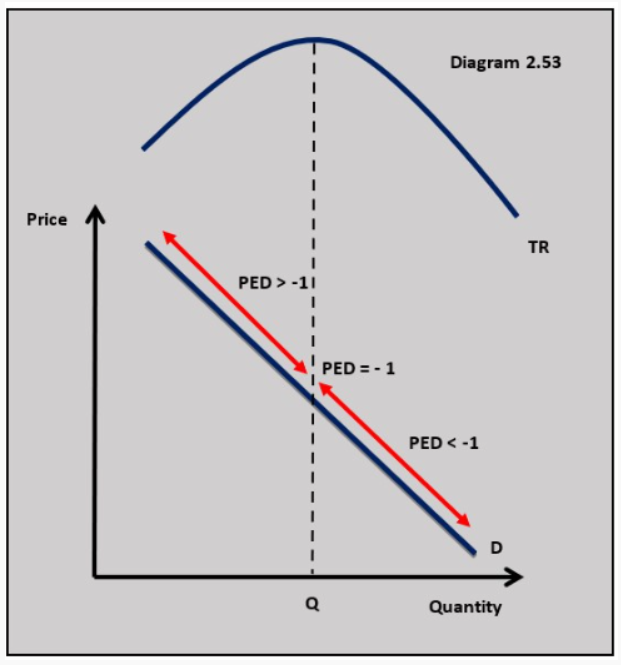 Relationship between PED and revenue
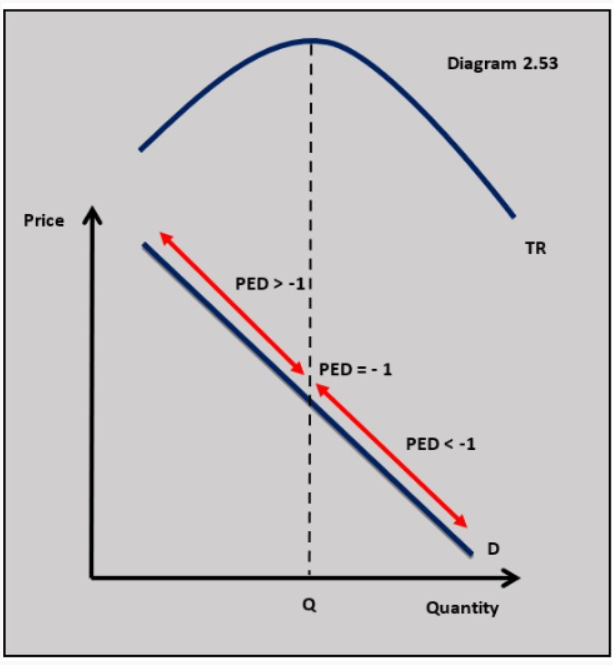
When the demand for a good is price elastic, total revenue increases when the price is decreased and decreases when the price is increased.
When the demand for a good is inelastic, total revenue increases when the price is increased and decreases when the price decreases.
Diagram 2.52 shows how revenue rises when price decreases when demand is price elastic and revenue falls when price decreases when demand inelastic.
The demand for commodities tends to be relatively inelastic because they are often necessities and have fewer close substitutes compared to manufactured goods.
The demand for manufactured goods tends to be relatively elastic because they are often relative luxuries, and there are a greater number of substitutes relative to commodities
The limitations of PED
- It can change over time as consumer behaviour changes.
- PED is based on the ceteris paribus assumption that price is the only variable that is changing. In reality, a number of factors can change at the same time as price such as income.
- When a firm changes price there is always going to be uncertainty about how consumers will react.
b. Using a real-world example, evaluate the usefulness of price elasticity of demand for producers trying to increase their revenues by raising prices. [15]

 Twitter
  Facebook
  LinkedIn