

This page covers the behavioural economics section of the course. This is an HL-only topic. Behavioural economics considers how psychology affects economic decision-making and offers an alternative approach to classical economics.
Nature of rational consumer choice
Behavioural economics offers a different view on consumer decision-making by considering an alternative to the classical economic perspective that people try to maximise their utility from their available income.
Behavioural economics considers consumer behaviour by using human psychology as part of the buyer decision-making process.
It considers how factors other than utility maximisation affect whether someone buys a good or not.
Nature of biases
Biases are the factors that influence individuals in decision-making situations and take them away from rational judgments.
Biases are influenced by heuristics. Heuristics mean simplifying decision-making when individuals cannot work out the option that will give them the greatest utility.
Consumers use heuristics to make mental shortcuts in buying situations because it allows them to make decisions in the time frame they are normally faced with.
The rule of thumb allows individuals to make decisions based on imperfect information allowing them to optimise their utility rather than maximise their utility.
Anchoring bias
Anchoring bias is a reference point in an individual’s mind based on the first piece of information an individual experiences and it strongly influences a decision they make.
 Anchoring bias comes from a series of past experiences and it can even be formed in the mind of a consumer from their first experience of buying a good.
 For example, when Apple first launched the iPad it was reported that the company would set a price of $999, but the actual launch price was $499. With a $999 'anchored' in the mind of potential consumers the $499 was a relatively attractive price.
Framing bias
Framing bias is the way decisions made by individuals are affected by the way choices are presented to them.
For example, consumers faced with a dessert in a supermarket would choose a product that says ‘80% fat-free’ rather than ‘20% fat’ because they are attracted by the word 'free'.
Availability bias
Availability bias considers how individual decision-making is affected by information that comes easily into someone's mind.
This information is often based on recent events and how the outcomes of these recent events affect our decision-making.
For example, if someone goes to catch a bus and it is late they will believe the bus service is unreliable even if the bus service is the most reliable in the area.
Nature of rationality
Classical economic theory assumes consumers make decisions in a rational way. Behavioural economists see this assumption as too simplistic and have developed alternative theories of rationality.
Bounded rationality
Bounded rationality is based on the theory that individuals make a decision that offers them a ‘good enough’ outcome rather than an ‘optimal’ or utility-maximising outcome.
The theory believes consumers are satisfiers, people who seek a satisfactory or acceptable outcome.
For example, a consumer in a fast-food restaurant may not research their choice in detail to work out the choice that will give them the highest utility. They are more likely to save time and quickly choose based on what looks appealing.
Bounded self-control
Bounded self-control is when individuals consume beyond the point where they maximise their utility when consuming a good.
For example, people often binge-eat fast food beyond the point where they are still enjoying it.
Bounded self-control can be important to governments when they are trying to regulate the consumption of certain goods.
Bounded selfishness
Bounded selfishness means individuals make decisions that benefit other people as well as themselves.
Classical economic theory considers individuals to be concerned with their own welfare and satisfaction and not others.
Bounded selfishness is important for charitable organisations and producers of fair trade goods that rely on people acting in the interests of others rather than themselves.
Classical economic theory assumes their decisions are made using perfect information. This means people buy goods and services and know what they are buying, and they can make an informed buying decision based on this.
Consumers often face imperfect information where they do not understand or know enough about the product they are buying and are unable to put an informed valuation on the good.
This is the case in markets such as cars and computers, where products are very technical and difficult for uninformed consumers to understand.
 Nature of choice architecture
Choice architecture is where a business sets the layout, sequence, and range of choices available to a consumer in a particular way to encourage them to make a buying decision.
Supermarkets, for example, put milk at the back of the shop to make buyers walk through the entire store.
Default choices
A default choice is an option the consumer selects as their normal course of action. This could be the brand of soft drink they always buy.
The choice is normally the easiest one for the consumer and requires the least effort.
Research shows consumers rarely change their default option and opt for an alternative.
An insurance company, for example, can more easily sell policies by offering customers automatic renewal.
Restricted choices
Restricted choice is based on the theory of bounded rationality.
If buyers are faced with too many choices they struggle to make buying decisions because they do not have the time to work their way through too many alternatives.
It is easier for businesses to sell to consumers if they offer them a limited number of choices.
For example, a retailer selling computer software to nonspecialist buyers might offer their customers a limited choice of software.
Mandated choices
A mandated choice is one where the consumer is forced to choose an option before they take part in an activity.
They are an important aspect of government policy where the state wants people to decide on something.
For example, governments in many countries force workers to choose a pension scheme from a set of alternatives.
Nudge theory
Nature of nudge theory
 Nudge theory is an area of behavioural economics developed by the 2017 Nobel Prize-winning Economists, Richard Thaler and Cass Sunstien in their book ‘Nudge’.
Nudge theory means using choice architecture to encourage people to make decisions that will improve their own welfare and society’s welfare.
A ‘nudge’ means making small changes to the choice environment an individual faces to affect their behaviour.
Nudge theory can be used by the government to achieve policy objectives.
An example of a 'nudge' policy is a greenhouse gas Inventory league table of the worst polluters to ‘nudge’ producers to reduce carbon emissions through a published league table.
a. Explain how a business can use choice architecture to increase the demand for the goods they produce. [10]
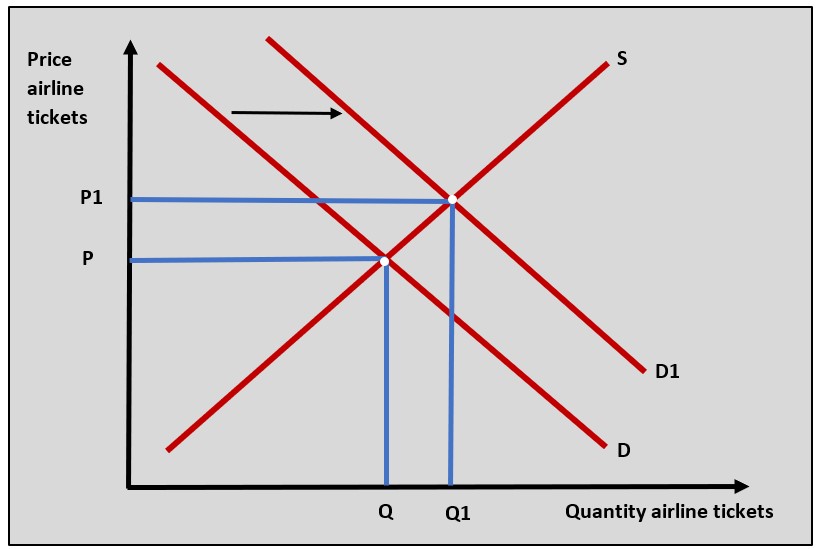 For example, an airline might take potential buyers through a series of web pages when they are booking a flight where they have to make decisions about buying add-on products the airline is selling such as holiday insurance increasing the potential demand for these products.
  Twitter
  Facebook
  LinkedIn