Define the economics terms not used in the first part of the essay (market forces, intervention).
Using accurate specialised terminology outline the key arguments in support of the decision to intervene in energy markets.
Demonstrates a balanced approach with an awareness of the impact on different stakeholders and the impact in both the short term and long term
Concise summary, consistent with the main body (do not add any new information in the conclusion)
Market forces can be described as when the price of a good or service in a market is determined by the free interaction of demand and supply. [Key terms defined]. The argument that governments need to intervene in energy markets is based on the belief, or perhaps suspicion, that without any intervention, the market is likely to lead to periods of wild variations in price and potential profiteering based on relatively small changed in market conditions. [Opening statement that supports the statement contained in the question]
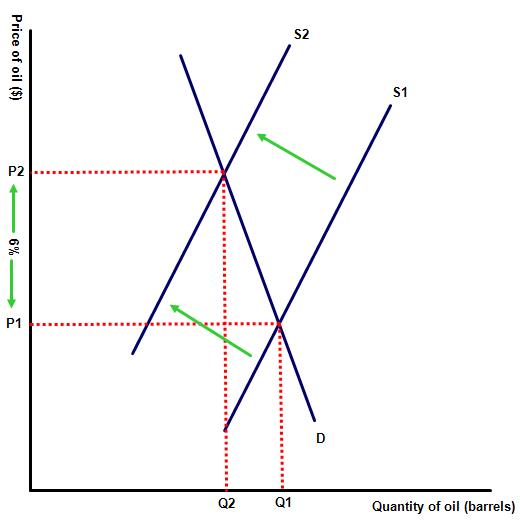 This can be seen within current energy prices, that have soared since the beginning of 2021 due to a combination of supply and demand factors. [Application of theory] Some of these are long-term such as an underinvestment in natural gas and clean energy supply, along with short-term factors, for example disruptions to supply from Russia and strong demand in the aftermath of the COVID-19 slump. [Real-world example]. This can be shown by the following diagram, illustrating the relative PES and PED inelasticity of the product. [Diagram]. With both supply and demand for energy being inelastic, with the production time for oil being long and the commodity qualifying as a basic necessity, any relatively small change in either supply or demand is likely to lead to a more than proportional change in price. [Explanation of diagram, showing both inelastic PES and PED]. As such, without some form of intervention, or at least government guarantees, both consumers and producers are likely to see very wild swings in prices, making producers reluctant to invest in long term projects and consumers facing periods of unaffordable prices. [Analysis]. For example, throughout 2022, news reports of vulnerable individuals almost freezing to death and businesses unable to continue due to prohibitively high energy prices have been wide circulated throughout many parts of the Europe, forcing many governments to intervene to bring down prices. [Real-world example]
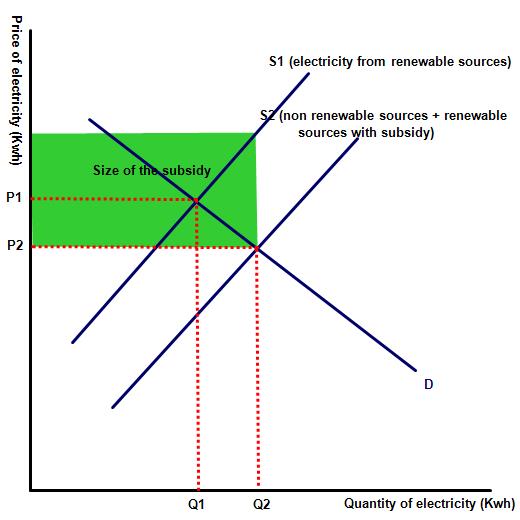 The case for intervention in clean/renewable energy supplies is particularly strong, with those energy sources more expensive than traditional (and more polluting) carbon based sources. [Example developed]. For example, in diagram two the supply of energy from renewable and carbon based sources is represented by S1 and S2, with the price of renewable energy more expensive and thus uneconomic without subsidy, represented on the diagram by the shift in supply, making the commodity viable for the first time. [Explanation of diagram, showing both inelastic PES and PED]. Therefore, any government hoping to power their economies via such methods will be forced to subsidise such markets (as well as tax carbon based energy sources) over the long term or see those sectors disappear completely. [Analysis].
That said, the argument for intervention is not entirely overwhelming, with some economists believing that long term energy security would be better served by allowing competition and market forces to determine future supplies and the arguments in support of this view are equally convincing. [Evaluation - counter argument against the statement contained in the question].
Exponents of this argument state that the free interaction of demand and supply will lead to the most efficient allocation of resources in the energy, as in all markets. [Application of theory]. For example, an incr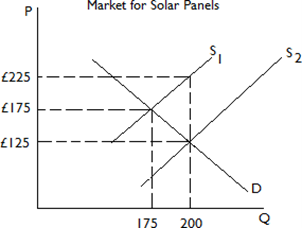 ease the demand for alternative energy sources because of a change in consumer tastes towards cleaner energy supplies will lead to a rise in supply, as energy suppliers target new markets that might be profitable and in the process divert resources away from less profitable goods and services. This is represented on the diagram by the rise in supply to S2, with the market clearing at the equilibrium price of £125. [Explanation of diagram, showing a rise in supply].
When the price of energy increases consumers and producers are provided with information to make decisions on how they might act in response to the price change. This is the signalling function of price. The rise in price (and therefore profit) acts as an incentive to increase quantity supplied to increase profits and an incentive for consumers to decrease quantity demanded to maximise utility. [Analysis].
The incentive and signalling functions of price lead to an efficient allocation of resources in the energy market. At this point the consumer and producer surpluses are maximised and allocative efficiency is achieved - something that would be impossible in a regulated market with government subsidies, taxes and regulated markets ensuring that markets remain inefficient and welfare loss created by inefficient production and the wrong kind of investment. [Argument developed].
In conclusion, therefore, the argument that governments must intervene in energy markets depends on the priorities of government, whether they take a short or long term view and whether the government chooses to prioritise market stability over long term efficiency. Finally, whether the energy producers can be trusted to invest sufficiently in new energy supplies to ensure that the market is sufficiently supplied? [Concise conclusion, consistent with the main body].
Terms included: PES, PED, market price, effiency, signalling, welfare loss, intervnetion, market forces.


 Examination style question 1 (unit 2.1-2.6)
 producers to produce the product at a given price, in a given time period.
  Twitter
  Facebook
  LinkedIn