


This page looks at the concept of market equilibrium. Equilibrium in markets occurs where demand equals supply and the market-clearing price and output are established.
Equilibrium
Equi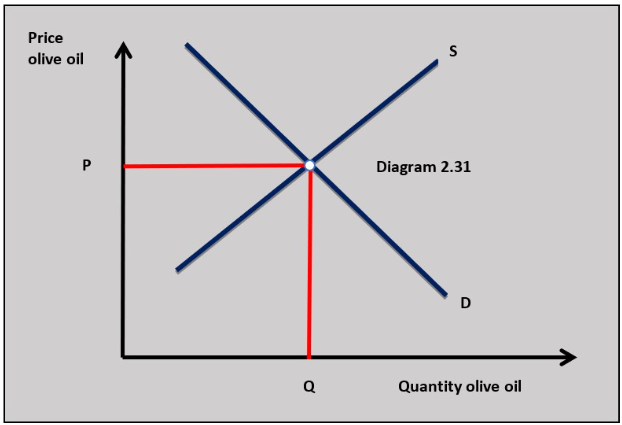 librium in markets occurs where demand equals supply and the market-clearing price and output are established.
Diagram 2.31 illustrates the equilibrium in the market for olive oil.
Disequilibrium
If the price of a good is not at the equilibrium level there is natural market pressure to push it to the equilibrium price.
The rationing function of price
The central economic problem of scarcity means there is always a limited supply of goods and services to be shared out amongst consumers. Price has a rationing function in this situation because it distributes goods so there are no shortages or surpluses.
The equilibrium price and quantity in a market will change if there is a change in either demand or supply.
Change in demand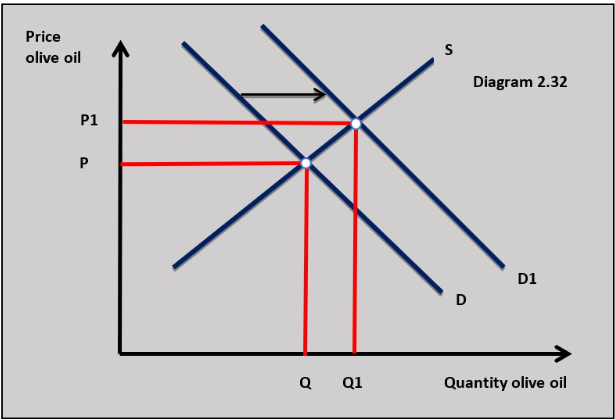
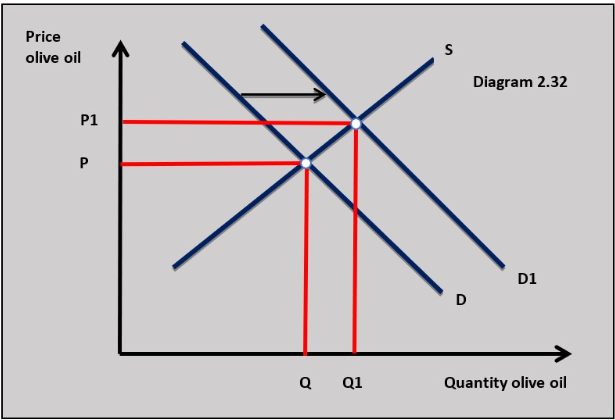
A change in a non-price demand factor that shifts the demand curve will lead to a change in the market equilibrium price and quantity.
Diagram 2.32 shows and increase in the demand for olive oil from D to D1.
Change in supply
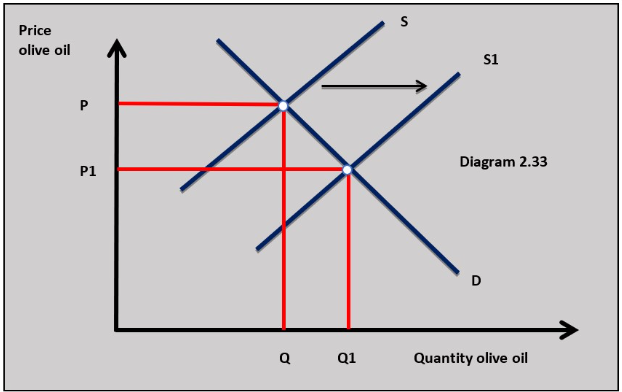 A change in a non-price supply factor will shift the supply curve and lead to a change in the equilibrium price and quantity.
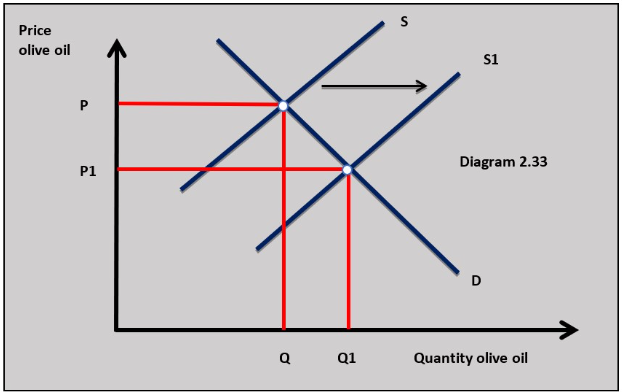
Diagram 2.33 shows an increase in the supply of olive oil because of a good harvest and the supply curve shifts from S to S1.
The allocation of resources
Resource allocation is the distribution of the factors of production to different markets in the economy.
In free markets, the price mechanism guides resources to different markets through what Adam Smith called ‘the invisible hand’.
The signalling function of price
When a price changes in a market, it sends information (a signal) to producers and consumers that market conditions are changing, and the price change provides producers and consumers with information to make decisions on how they might act in response to the price change.
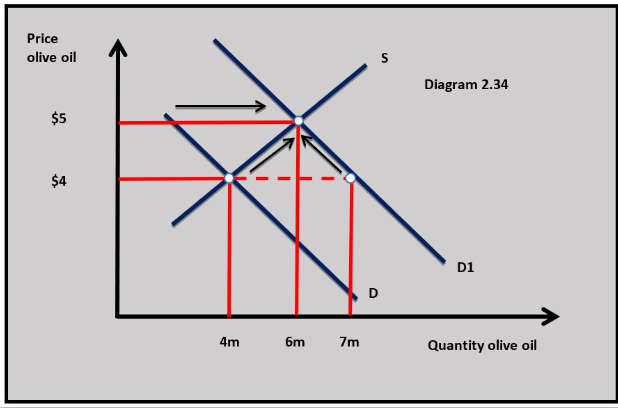
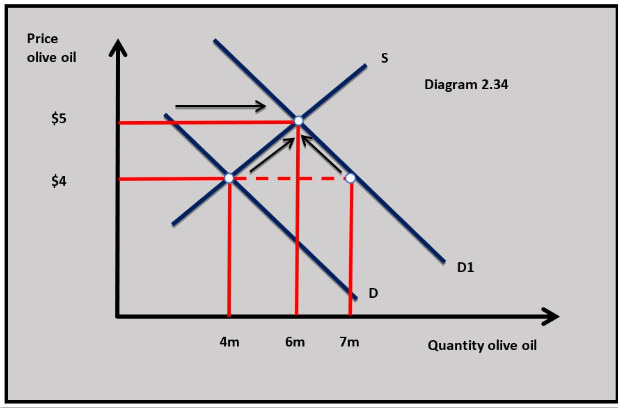
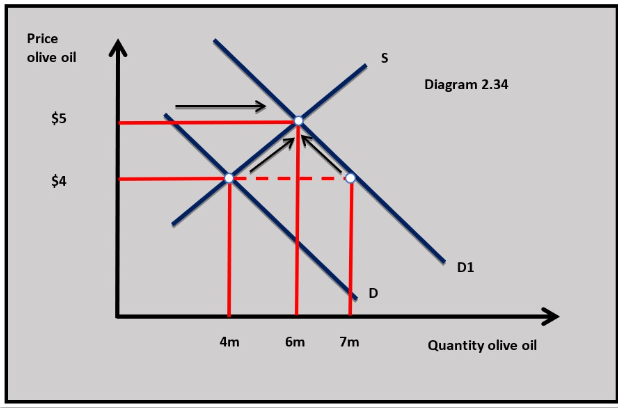 Diagram 2.34 an increase in demand for olive oil, there will be excess demand at the existing market price of $4 per litre. For the market to clear the market price needs to rise.
The rise in price is a signal to consumers and producers in the olive oil market that market conditions are changing and provides them with information to make buying and selling decisions.
The incentive function of price
Once a price change has sent a signal to consumers and producers, they react to the price change based on the incentive to try and maximise their profits, in the case of producers and utility in the case of consumers.
As the price of olive oil rises in diagram 2.34 producers have the incentive to increase the quantity they supply because the higher price means they can earn more profit from increasing the quantity supplied.
The quantity demanded of olive oil falls as the price increase means consumers receive less utility for each $ they spend on olive oil and they have less incentive to consume olive oil.
When quantity demanded equals quantity supplied the market reaches an equilibrium price of $5 with 6 million litres traded.
Market efficiency
Allocative efficiency
Market allocative efficiency occurs when the quantity of resources allocated to a market maximises the community or social surplus in that market.
This means resources are allocated so that the consumer and producer surplus are both maximised.
This occurs when demand equals supply in a market.
Consumer surplus
The consumer surplus is the difference between the price the consumer is willing to pay for a good and the market price of that good.
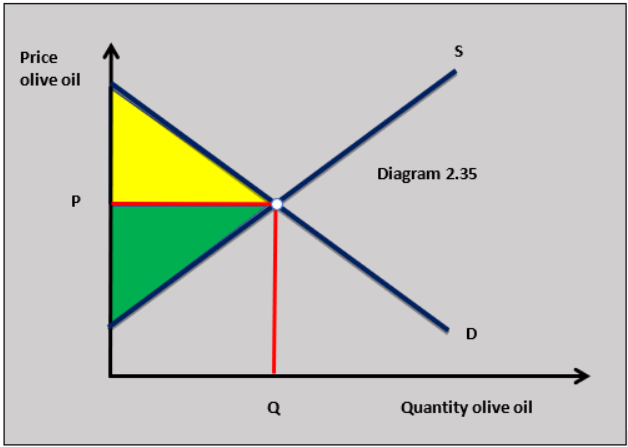
The consumer surplus is shown by the yellow shaded area in diagram diagram 2.35.
Producer surplus
The producer surplus is the difference between the price the producer is willing to sell their good for and the market price of the good.
The producer surplus is shown by the green shaded area in diagram 2.35.
Social (Community) surplus
Welfare is maximised in society when the social or community surplus in a market is maximised. This is where the benefit to society of the production and consumption of a good is equal to its cost.
The social surplus is the sum of the consumer surplus and producer surplus in a market.
Diagram 2.35 this is the total area represented by the green and yellow triangles.
Explain how the price mechanism allocates resources in a free market economy. [10]
 The signalling and incentive functions of price are shown in the diagram where excess demand occurs at price P and quantity demand and quantity supply both change to reach the new equilibrium at price P1 and output Q1 in the diagram.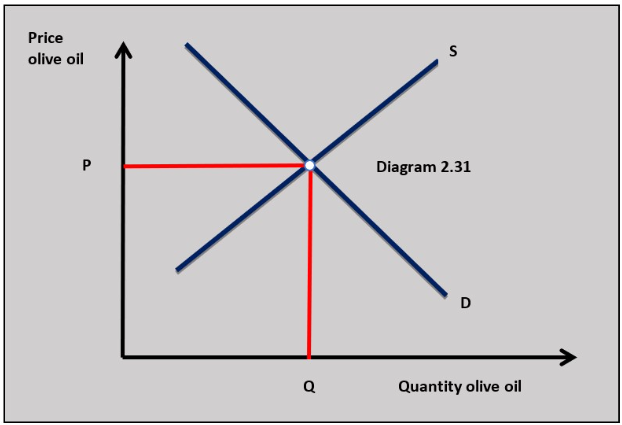
 Twitter
  Facebook
  LinkedIn