Define the economics terms not used in the first part of the essay (merit goods and market failure).
Using accurate specialised terminology outline the key arguments in support of the decision to provide merit goods free at the point of use.
Demonstrates a balanced approach with an awareness of the impact on different stakeholders and the impact in both the short term and long term
Concise summary, consistent with the main body (do not add any new information in the conclusion)
Command term: Evaluate
This response will consider whether or not governments should provide merit goods (or some merit goods) free at the point of use and will consider the impact on a range of different stakeholders e.g. consumers of merit goods, tax payers, high income earners and low income earners.
Merit goods consist of services considered to be socially desirable and are generally under-produced and under-consumed in a market system. Examples include education and health services. [Introduction]
An argu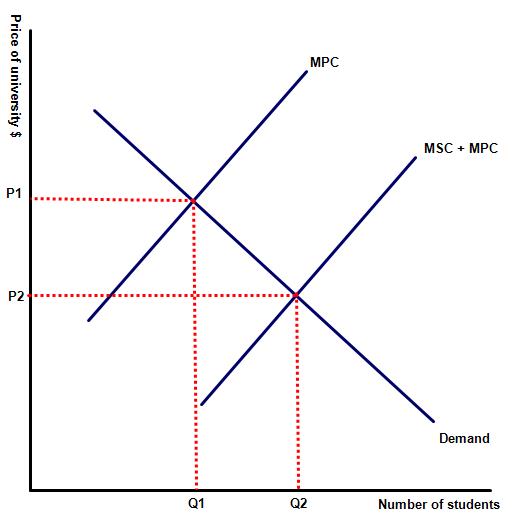 ment to support of this view is that, left up to the free market, merit goods such as education, health or public transport will be under consumed if consumers are forced to pay the full price of the good or service. This is because consumers (as human beings) only consider their own private benefits when making a purchasing decision and do not consider the external benefits enjoyed by others. This is demonstrated on the diagram to the right, which illustrates the market for university places. University education is considered a merit good providing external benefits, in terms of a more educated workforce (MEBs), as well as private internal benefits to the student, shown by MPB. In the diagram it can be observed that the socially optimum level of output is represented by Q2. However, without any intervention from the government, consumption and output remain at Q1 and the price at P1. This means that there is a potential loss to society (shown by the green triangle) represented by the fact that fewer students attend university. Governments can close this welfare gap by subsidising the good or service or even providing it free of charge. [Argument in support of the decision]
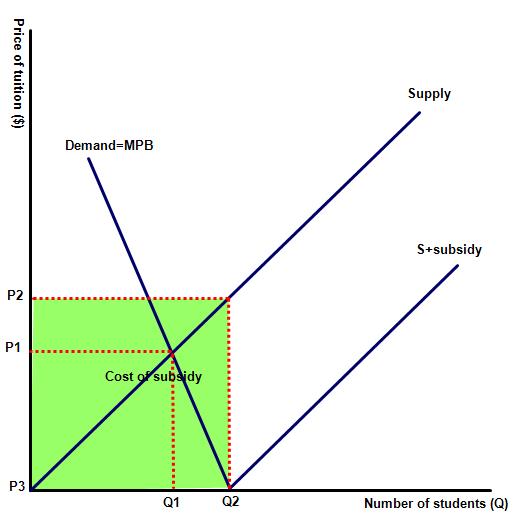 The next diagram to the left, for instance, illustrates the impact of a government subsidy on university education, with the cost of the subsidy represented by the green shaded area and the number of students at university rising to the socially optimum level of Q2. Under this model university becomes free at the point of entry (P3) while the tax payer pays the whole burden. Arguments in support of this theory state that such a policy will lead to higher external benefits to society as the welfare loss is eliminated. Specifically this could mean an economy enjoys the benefits of a better educated and healthier population, amongst other benefits. [Argument developed]
This notion of providing merit goods free at the point of use can also be applied to other services, a good example being healthcare, with many European nations providing healthcare free at the point of sale and this method is also widely used by governments to encourage citizens to 'do their civic duty' and vaccinate themselves against Covid-19 as well as other common viruses. [Use of real life example]
On the other hand, the policy also has disadvantages. For example, before the policy can be implemented governments must first agree upon which public services offer sufficient external benefits to qualify for the subsidy and consider the opportunity cost of any investment? There is clearly agreement over education but until what age? Should students be offered free courses indefinitely, or would there be a cut off point? Is it morally correct for young people, likely to rewarded with higher paid careers in the future, to be subsidised by those not fortunate enough to attend? [Counter argument 1]
Equally another disadvantage includes the physical / psychological crowding out of the private sector by free public services and this can be seen throughout government health care sectors across the world, in the form of patients in genuine need forced to wait for an appointment due to over demand for services provided free of charge. This can regularly be seen in state funded medical services where wards and accident and emergency services are frequently over crowded with patients requesting services that they might not necessarily do were they required to fund or part fund the service from their own pocket? [Counter argument 2]
In conclusion, therefore, the argument that merit goods should be provided free of charge comes down to the relative external benefits enjoyed by the consumption of different merit goods, as well as the question of who should pay? Should it be the consumer who enjoy the majority of the benefit (in the form of their own MPB) or should the cost of such provision also be shared by those receiving the MSB, which is the whole population? [Summary paragraph]
Specialised terminology used in answering the question:
Merit goods, welfare loss, MPB, MSB, MSC, MPC, subsidy, opportunity cost.


 1. (a) Explain why the consumer is sovereign in free-market economies. [10 marks]
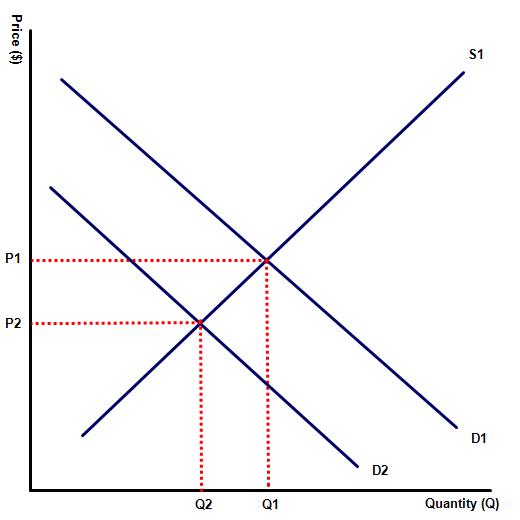 The benefits of a free market economy to consumers can be shown by the diagram to the right, which illustrates the market for hotel rooms in Turkey.
  Twitter
  Facebook
  LinkedIn