


This page covers the nature of demand theory, the law of demand, utility theory and the non-price factors that affect demand.
The market is a central feature of the study of microeconomics. 
A market for a good or service exists where buyers and sellers interact and the price and quantity of the product traded is established.
Markets can be narrowly defined (the market for designer sunglasses in South Africa) or broadly defined (the world energy market).
Neoclassical economic theory focuses on the interaction of demand and supply in markets.
Demand is the willingness and ability of consumers to pay a sum of money for a good or service at a given price and at a given point in time.
Individuals want to buy goods and services because of the satisfaction (utility) they gain from consuming them.
Law of demand
The law of demand states there is an inverse causal relationship between the price of a good and the quantity demanded for it.
As the price of a good or service rises, the quantity demanded falls, and as the price of a good falls, the quantity demanded rises.
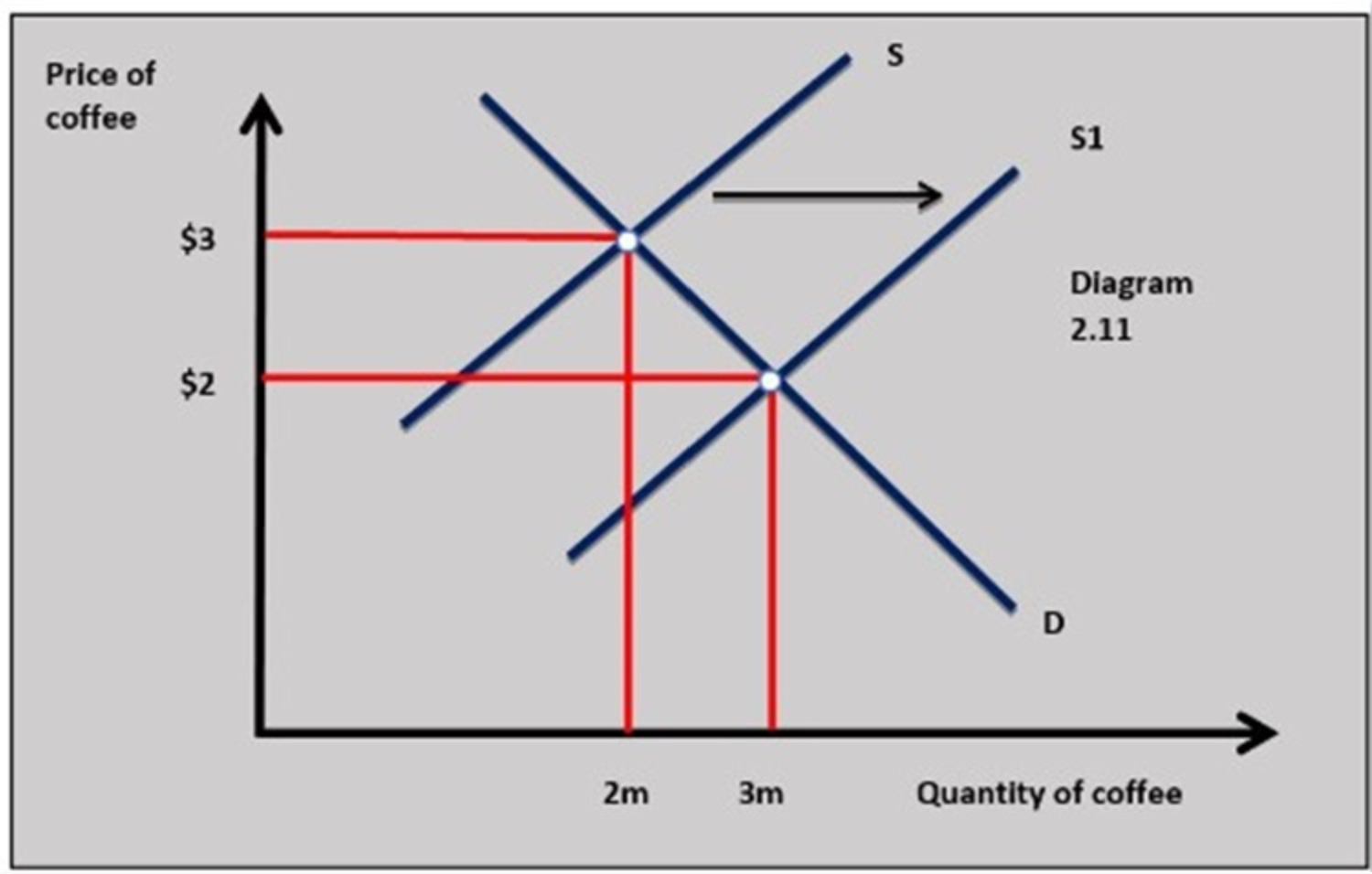 The demand curve or demand schedule shows the negative relationship between the price and quantity demanded of a good or service.
Diagram 2.11 shows the demand curve for coffee as the price of coffee decreases.
The real income effect (HL): As the price of a good falls, the quantity demanded increases because at lower (higher) prices, consumers can afford more of the product than at higher prices (vice versa).
Substitution effect (HL): As the price of a good falls, the quantity demanded rises partly because the good offers greater satisfaction to the consumer per unit of money spent compared to its substitutes (vice versa).
The law of diminishing marginal utility
Utility theory is based on the satisfaction an individual receives from consuming a good or service.
A person’s satisfaction can be measured in terms of the number of utils they gain from consuming a good or service. A util is a unit of satisfaction.
Total utility is the total satisfaction measured in utils an individual derives from consuming successive units of a good.
Marginal utility is the satisfaction measured in utils an individual receives from the last unit of the good they consume.
The law of diminishing marginal utility states that for each extra unit of a good consumed by an individual, the marginal utility they receive from consuming the good falls.
The table shows the utility a person receives from consuming increasing units of chocolate biscuits.
As an increasing number of units are consumed by someone by the marginal utility they receive from each unit falls and the price they are prepared for a unit of the good decreases - the law of demand.
| Units consumed | Total utility (utils) | Marginal utility (utils) | Price consumer is prepared to pay $ |
|---|---|---|---|
| 1 | 12 | 12 | 0.40 |
| 2 | 21 | 9 | 0.30 |
| 3 | 26 | 5 | 0.15 |
| 4 | 28 | 2 | 0.06 |
| 5 | 28 | 0 | 0.00 |
Market demand
The market demand curve for a good or service is derived by summing the demand curves of all the individuals in the market.
Substitutes
A substitute for a good is an alternative product that can be used to satisfy a similar want in place of a good.
There is a positive relationship between the price of a substitute for good n and the demand for the good n. The price of a substitute for a good increase, and the demand for the good increases (and vice versa).
Changes in the price of a substitute for good n cause a change in demand for the good n, and the demand curve shifts.
Complements
A complement is a good that can be consumed together with another good.
There is a negative relationship between the price of a complement for good n and the demand for good n. If the price of a complementary for good n decreases, the demand for good n (vice versa).
 Changes in the price of a complement for good n causes a change in demand for the good n and the demand curve shifts.
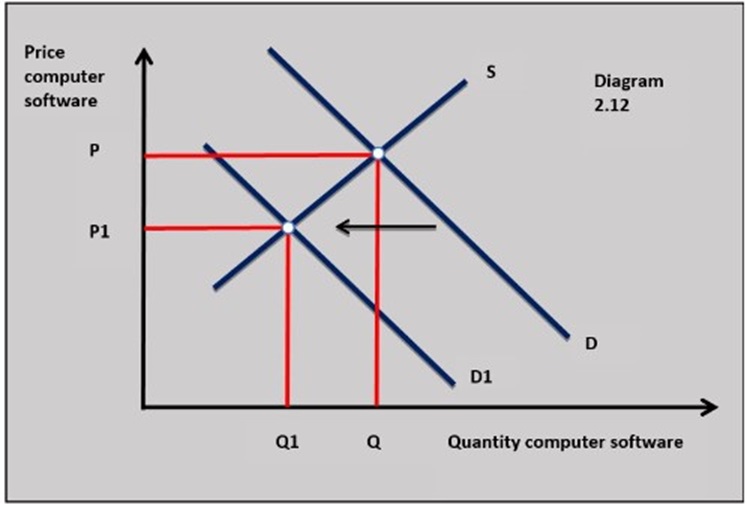
Diagram 2.12 shows the demand for computer software decreasing from D to D1 as the price of personal computers (a complement) increases.
Normal goods
Normal goods demonstrate a positive relationship between income and demand. As income rises, the demand for normal goods rises (vice versa).
Most goods are normal goods.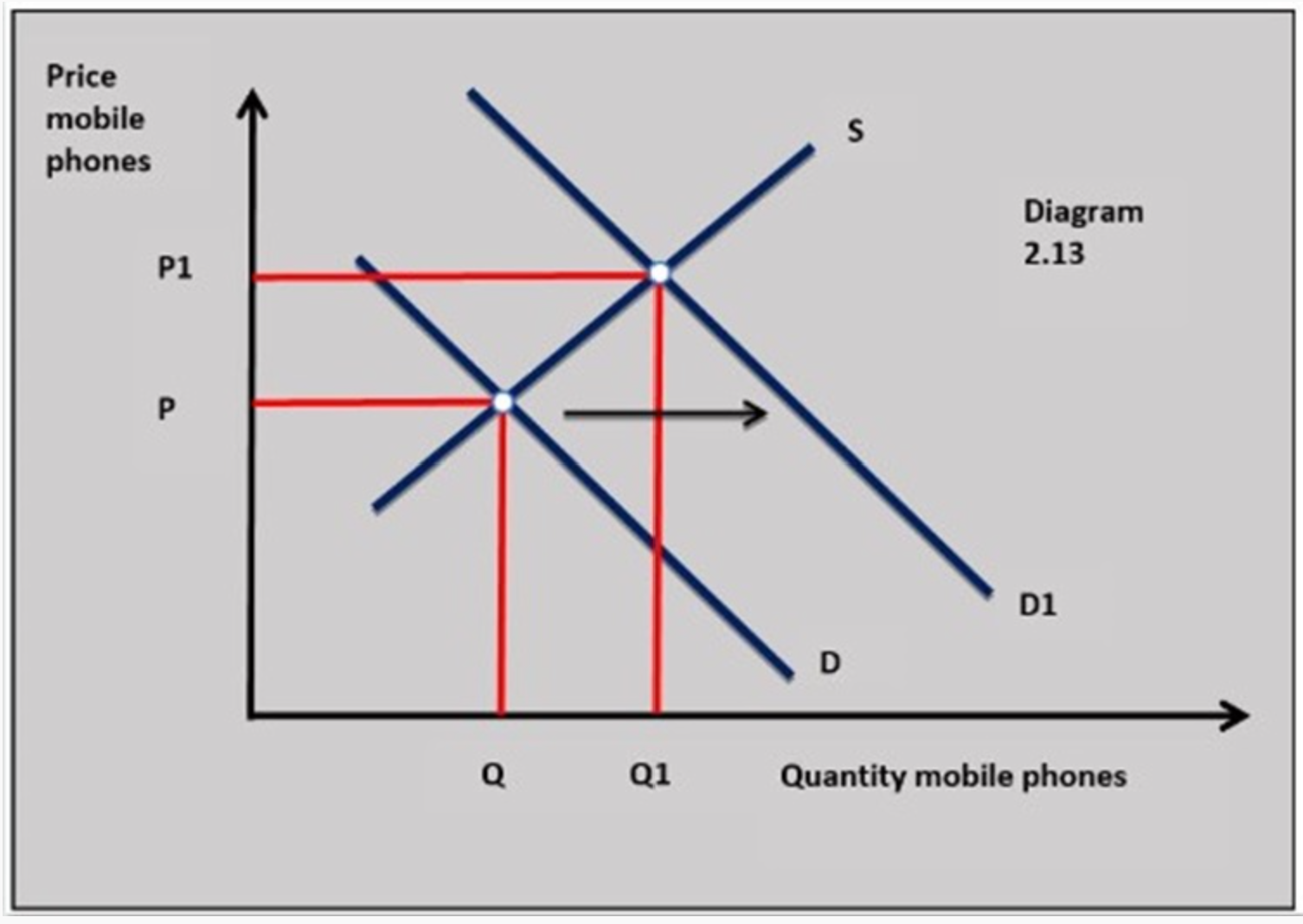
Changes in income cause shifts in the demand curve for a good.
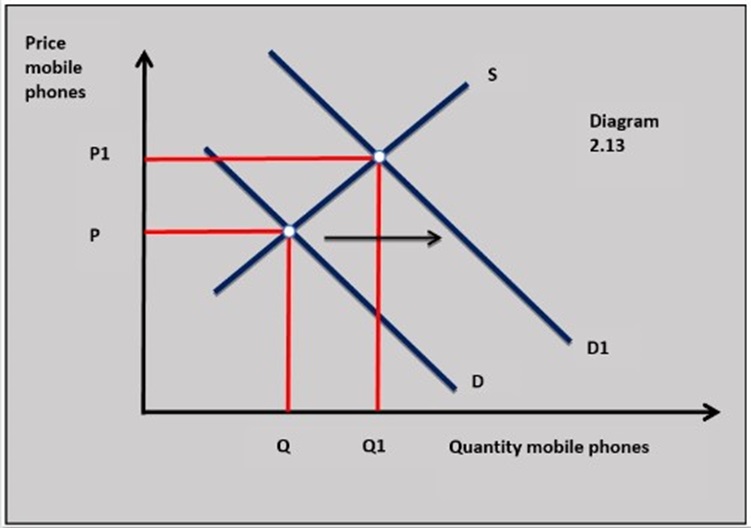
A rise in income would lead to a rise in demand for mobile phones, as shown in diagram 2.13, where demand increases from D to D1.
Necessity goods
Necessity goods are a type of normal good. They are goods that consumers need to sustain their normal lives.
Examples include basic staple foods like bread and rice, housing, electricity and clothing.
As household incomes rise, demand for necessity goods will increase, but at a less than proportionate rate than the increase in income.
Luxury goods
Luxury goods are another type of normal good. Economists sometimes refer to luxury goods when a strong positive correlation exists between income and demand.
As household incomes increase, the demand for luxury goods increases by a greater than proportionate rate relative to the rise in income.
Luxury goods applies to goods and services consumers do not need to buy to sustain their lives, such as holidays, branded clothing, restaurant meals and tickets to the cinema.
Inferior goods
Inferior goods show a negative relationship between income and demand.
As household incomes rise, the demand for an inferior goods falls (vice versa).
This relationship often applies to lower-priced goods such as tinned fruit and vegetables, processed meats and manmade fibre clothing.
Population and demographics
Population growth at a national or local level will cause a rise in demand for many goods and services.
At a global level, a rise in the world’s population leads to a rise in demand for goods such as food and water.
An ageing population in many developed countries has led to a rise in demand for healthcare-related goods and services.
Consumer taste
A change in consumer taste in favour of a good will lead to an increase in demand (vice versa).
Consumer tastes change over time due to social and cultural changes.
Firms can influence consumer taste through advertising and promotion.
Price expectations
The demand for a good or service in the present can be affected by consumers’ expectations of what the price for that product might be in the future.
If consumers believe the price of a good will rise in the future, it will increase the demand for the good in the present (and vice versa). Expectations are particularly important in asset markets like shares and houses.
Explain three reasons why the demand for fast food might increase in a market. [10]
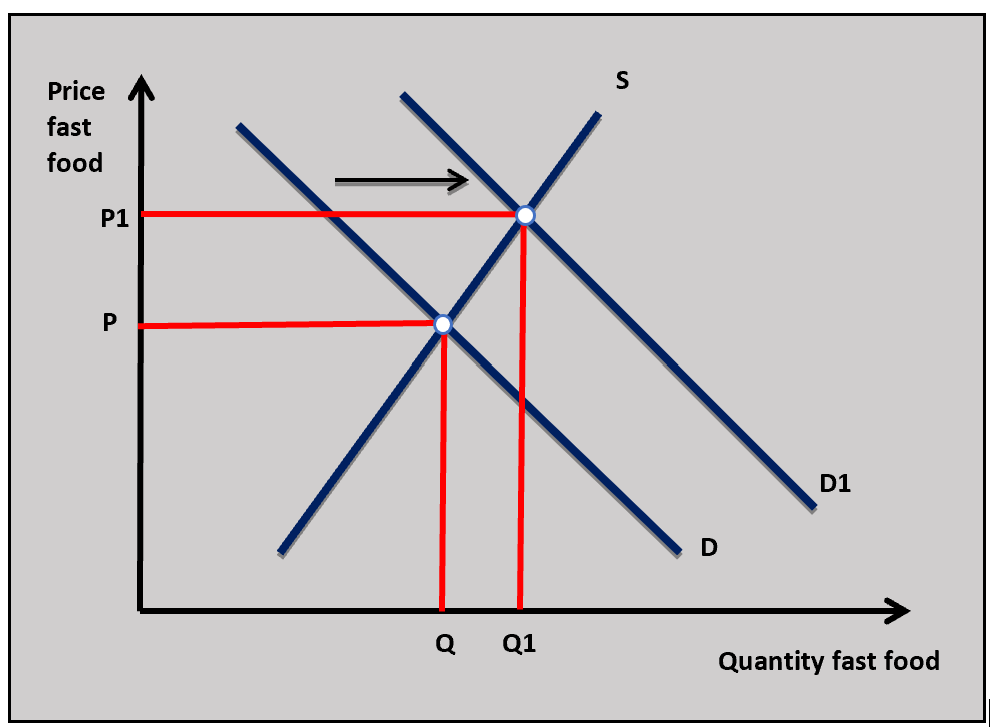 The diagram shows an increase in demand for fast food with D increasing to D1.
 Twitter
  Facebook
  LinkedIn